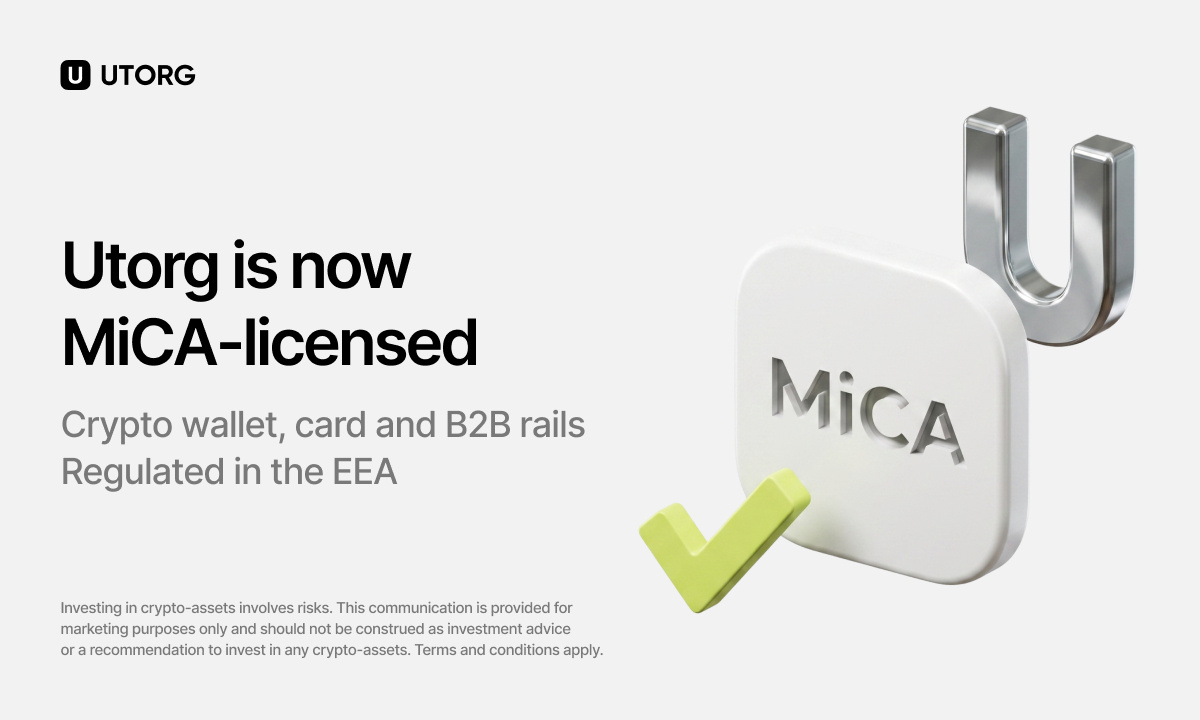
The crypto wallet and card provider Utorg has officially secured its license under Europe's Markets in Crypto-Assets (MiCA) framework, ensuring it remains operational while many competitors face exclusion.
Utorg has successfully obtained full authorization under the European Union’s Markets in Crypto-Assets (MiCA) regulation, securing its future in one of the world's most strictly regulated digital asset markets.
On July 1, 2026, the European crypto landscape changed forever as the transitional period for unregulated firms officially ended. Utorg, an institutional-grade crypto payment platform, stands as one of the few global entities to meet these rigorous standards early. This development is a major signal to USA investors that the era of "wild west" crypto operations is closing, as Europe sets a legislative blueprint that often influences American policy makers.
The End of the Transitional Era in Europe
For years, crypto firms operated in a gray area across Europe, but the July 1 deadline marks a hard line in the sand. MiCA represents the first comprehensive set of rules for digital assets across a major economic bloc. Any firm without a license is now legally barred from offering services to EU citizens.
Utorg’s move to secure this authorization highlights the growing importance of compliance (following legal rules and regulations). While some firms chose to exit the market due to high costs, Utorg doubled down on its infrastructure. This reflects a broader trend where only the most well-capitalized and transparent companies survive.
"The MiCA framework is more than just a hurdle; it is a filter that separates long-term industry players from fly-by-night operations that lack consumer protections."
Why Institutional-Grade Infrastructure Matters
Utorg’s platform focuses on providing a bridge between traditional finance and digital assets. By using institutional-grade infrastructure (high-security systems used by large banks), the company aims to reduce the risks associated with custody (holding assets on behalf of others).
For users, this means lower risks of hacks and better integration with debit cards and bank transfers. As more people seek out this Investopedia DeFi explainer to understand how finance is evolving, the bridge provided by licensed entities like Utorg becomes essential for safety.
- Vetted Security: Licensed firms undergo regular audits.
- Consumer Protection: Users have legal recourse in case of disputes.
- Market Stability: Heavy regulation reduces the chance of systemic crashes.
Comparing MiCA to the US Regulatory Landscape
US investors may find the MiCA rollout enviable compared to the current "regulation by enforcement" approach used by the Securities and Exchange Commission (SEC). While Europe now has a clear rulebook, the US remains divided between various agencies and state-level laws.
- Clarity: MiCA provides a single license that works across 27 countries.
- Complexity: In the US, firms must often navigate the SEC, CFTC, and individual state licenses like the New York BitLicense.
- Adoption: Clear rules in Europe could lead to faster institutional adoption compared to the uncertain US environment.
What This Means for USA Investors
While Utorg primarily serves the European market, its success under MiCA has direct implications for Americans. First, many US-based platforms like Coinbase and Kraken are also seeking global licenses to ensure they can serve international clients without interruption.
From an IRS tax perspective, using a regulated platform makes reporting much simpler. Licensed platforms are more likely to provide clean data for Form 8949. Furthermore, the SEC is watching Europe’s experiment closely; if MiCA succeeds in preventing fraud without stifling innovation, we may see similar "comprehensive" legislation proposed in Congress. For now, US investors should prioritize exchanges with strong balance sheets and transparent reserve reporting.
The Future of Cross-Border Crypto
As the world’s financial borders tighten, the ability to move USD or Euro into digital assets legally is becoming a premium service. Platforms that fail to adapt are being "de-banked," losing their connections to traditional payment networks. Utorg’s licensing ensures its cards and wallets remain a viable gateway for the foreseeable future.
Investors should view these headlines as a sign of industry maturation. The move toward licensed providers may result in slightly higher fees or stricter KYC (Know Your Customer) identity checks, but it significantly lowers the "existential risk" of a platform disappearing overnight with user funds.
Key Takeaways
- Navigate the new July 1, 2026, deadline that mandates all EU crypto providers be fully licensed.
- Recognize Utorg as a survivor in a market where many unauthorized firms are being forced to exit.
- Understand the impact of MiCA on global standards for institutional-grade crypto infrastructure.
- Evaluate how MiCA sets a precedent that the US SEC and CFTC are monitoring closely.
- Observe the shift toward regulated fiat-to-crypto gateways for safer retail participation.