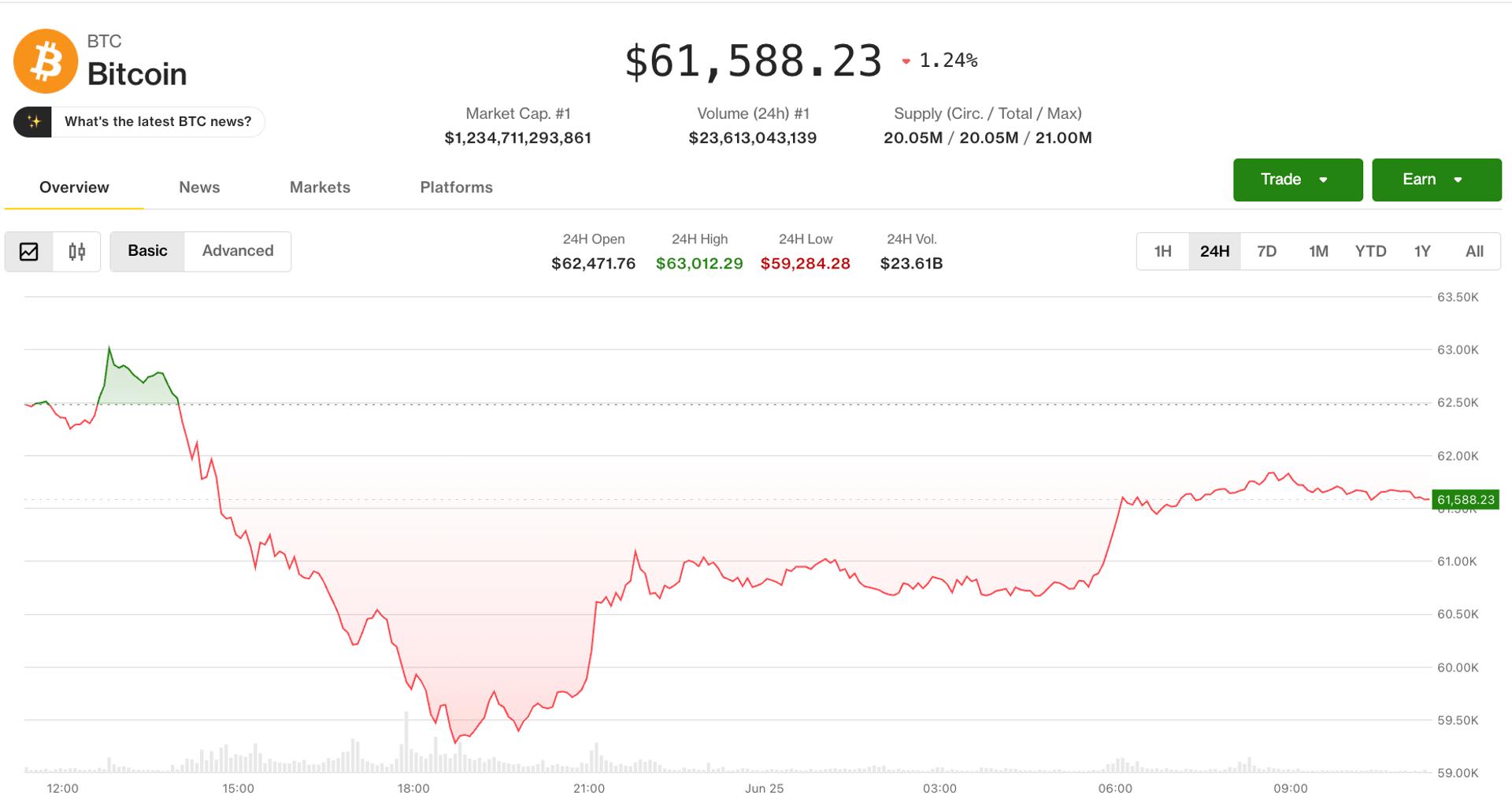
The recent uptick in Bitcoin and Ethereum prices appears to be a fragile relief rally driven by traditional stock market gains rather than a fundamental shift in crypto sentiment.
Bitcoin and Ethereum prices are bouncing back alongside US stocks, but professional traders are betting on further drops through bearish derivatives signals.
As Wall Street opened to green candles this week, the cryptocurrency market followed suit, lifting Bitcoin (BTC) and Ethereum (ETH) off their painful weekly lows. For American investors watching their Robinhood or Coinbase apps, the green numbers offer a moment of breathing room after a period of intense selling pressure.
Market analysts are currently weighing whether this jump is a "dead cat bounce" (a temporary recovery in a falling market) or the start of a genuine recovery. While prices are higher today, professional data from the derivatives market—where traders bet on future price movements—suggests that the big players are still bracing for a possible downturn in late 2024 and beyond.
Why Derivatives Are Flashing a Red Light
While the "spot" price (the current market price for immediate delivery) is rising, the derivatives side of the house is acting more cautious. Professional traders often use options and futures to hedge their bets, and currently, the demand for protection against a price drop remains unusually high.
Specifically, the Cumulative Volume Delta (CVD)—a metric that tracks the net difference between buying and selling volume—remains in negative territory. This indicates that even as the price ticks upward, aggressive sellers are still offloading their coins into every small bounce. When sellers are more aggressive than buyers during a rally, the upward move often lacks the "legs" needed to sustain long-term growth.
"The divergence between rising prices and falling CVD is a classic warning sign that the current rally is fueled by short-term liquidations rather than organic, long-term accumulation."
The Connection Between Wall Street and Web3
One of the primary drivers for this recent bounce has been the recovery of major U.S. stock indices like the S&P 500 and the Nasdaq. Bitcoin has increasingly behaved like a "high-beta" tech stock, meaning it moves in the same direction as the stock market but with much more intensity.
According to data on CoinGecko, the total crypto market capitalization often mirrors the risk appetite of institutional investors in Manhattan and Chicago. When Treasury yields stabilize and tech stocks rally, crypto usually follows. However, if the Federal Reserve signals higher interest rates for longer, this correlation could lead to a swift reversal of today's gains.
Technical Indicators to Watch Close
Intermediate investors should keep a close eye on several key technical levels and market behaviors. The following factors are currently dictating the strength of the crypto market:
- Funding Rates: The cost to hold long positions in the futures market; currently staying neutral to slightly negative.
- Exchange Reserves: The amount of BTC held on platforms; a decrease usually suggests investors are moving coins to private storage.
- Liquidation Heatmaps: Visual tools showing where high concentrations of stop-loss orders are located.
Breaking Down the CVD Signal
Negative CVD simply means that market participants using "market orders" (buying or selling immediately at the best available price) are leaning toward the sell side. This suggests that the price increase might be driven by "limit orders" (passive buying) being hit, which is generally considered a weaker form of support than aggressive market buying.
What This Means for USA Investors
For investors based in the United States, this market uncertainty has specific implications. The SEC (Securities and Exchange Commission) continues to monitor market volatility, and rapid price swings can lead to increased scrutiny of retail trading platforms. Furthermore, the IRS treats every crypto-to-crypto trade as a taxable event, so selling into a relief rally requires careful record-keeping of your cost basis.
- Tax Implications: If you sell your BTC during this rally for a profit, you will owe capital gains taxes at the federal and potentially state level.
- Exchange Access: US-regulated exchanges like Coinbase, Kraken, and Gemini offer different levels of liquidity, which can affect the "slippage" (price difference) you experience during volatile rallies.
- USD Strength: A strong US Dollar (DXY) typically puts downward pressure on Bitcoin, so keep an eye on the greenback's performance.
How to Position Your Portfolio Now
In a bearish-leaning environment, many intermediate investors opt for "dollar-cost averaging" (investing a fixed dollar amount at regular intervals) rather than trying to time the exact bottom of a relief rally. This strategy helps mitigate the risk of buying exactly when the derivatives market is signaling a trap.
While the excitement of a green day is contagious, the underlying data suggests caution. Until we see a sustained shift in CVD and a cooling of bearish derivatives bets, the smart money in the US is likely keeping a close watch on the exits while enjoying the temporary price lift.
Key Takeaways
- Identify the 'relief rally' as a short-term price bounce rather than a long-term trend reversal.
- Monitor negative CVD (Cumulative Volume Delta) to spot when sellers are overpowering buyers.
- Evaluate the strong correlation between US equity markets and current cryptocurrency price swings.
- Prepare for potential volatility as professional traders maintain bearish positions in futures markets.
- Consult regulated US exchanges like Coinbase for real-time order book transparency during rallies.