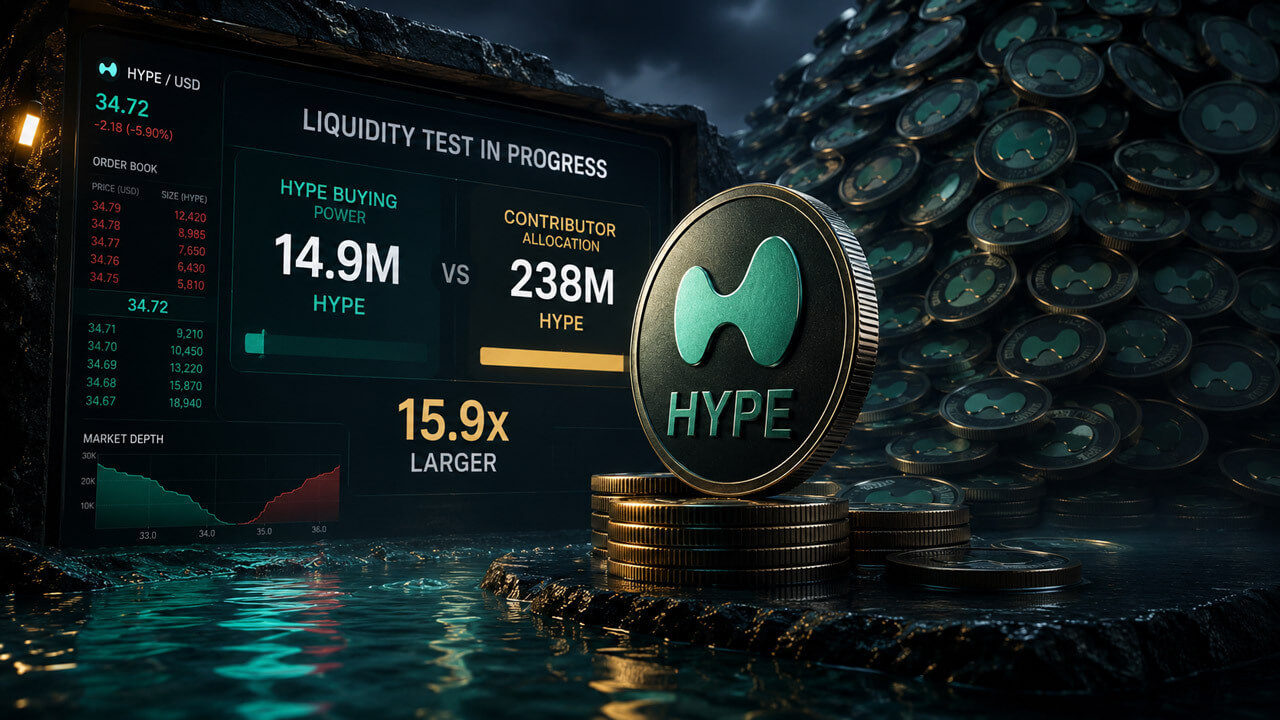
Hyperliquid is attempting to execute a $1 billion treasury strategy using its native HYPE token, despite facing significant hurdles regarding market liquidity and the need for future capital raises.
Hyperliquid is launching a $1 billion treasury strategy centered on its HYPE token, but recent filings suggest the project may struggle to maintain token value while raising necessary capital in thin markets.
The decentralized exchange (DEX) ecosystem is watching closely as Hyperliquid—a popular platform for perpetual swaps (crypto derivatives that don't expire)—moves its native token, HYPE, into the public eye. Recent filings indicate a massive $1 billion valuation for its treasury holdings.
For US investors, this move represents a critical test of how "app-chains" (blockchains built for specific applications) manage their internal economies. While the project aims to enrich shareholders through token accumulation, it must balance this against the harsh reality of needing cash to fund operations.
The $1 Billion Treasury Dilemma
At the heart of the issue is the HYPE token, the primary asset fueling the Hyperliquid Layer 1 (a base-level blockchain network). The project has structured its treasury to be heavily weighted in its own native currency.
While a $1 billion figure looks impressive on a balance sheet, it is often referred to as "paper wealth." This is because the liquidity (the ability to buy or sell an asset without changing its price) for HYPE has not yet been tested at such a massive scale.
If the project needs to sell tokens to pay for developers or marketing, the act of selling could drive the price down significantly. This creates a recursive loop where the treasury's value drops exactly when the project needs it most.
SEC Filings Reveal Strategic Friction
Public filings, similar to those required by the Securities and Exchange Commission (SEC), show that Hyperliquid faces a fundamental challenge. The leadership wants to hold more HYPE to increase scarcity, yet they acknowledge the need for future capital raises.
This means investors are caught between two opposing forces:
- Accumulation: The desire of the protocol to keep HYPE off the market to support the price.
- Dilution: The necessity to issue or sell new tokens to venture capital firms or the public to raise USD.
- Volatility: Price swings caused by a lack of deep buy orders on exchanges.
"The challenge for emerging protocols is not just creating value, but ensuring that value can be converted into operational capital without crashing the market for retail users."
Understanding Hyperliquid’s Market Position
Hyperliquid has gained traction by offering a fast, low-cost environment for perpetual futures (contracts that allow traders to bet on the future price of crypto). Unlike traditional exchanges, it operates on its own dedicated blockchain.
Data from CoinGecko shows that the DEX (decentralized exchange) sector is becoming increasingly crowded. To stand out, Hyperliquid is betting that its HYPE token will provide enough utility (actual use cases) to sustain its billion-dollar valuation.
- The platform uses HYPE for staking (locking up tokens to secure the network).
- Token holders may receive a share of trading fees generated by the platform.
- Governance rights allow users to vote on future protocol upgrades.
Navigating the Liquidity Gap
Liquidity is the lifeblood of any financial asset. For HYPE, the order books (lists of buy and sell orders) are currently thin compared to established assets like Bitcoin or Ethereum.
When a treasury holds $1 billion of an asset but only a few million dollars move in daily trade volume, the treasury is functionally locked. Investors should be wary of "FDV" or Fully Diluted Valuation, which reflects the total value if every single token were in circulation.
Risks of Early-Stage Treasury Trades
Early investors often face "lock-up periods" where they cannot sell their tokens. As these periods end, a massive amount of HYPE could hit centralized exchanges (platforms like Coinbase or Kraken), testing the market's appetite to buy at current prices.
What This Means for USA Investors
For Americans, the Hyperliquid story involves several layers of complexity. First, the IRS tax treatment for native token distributions is strict; any "airdropped" or earned HYPE tokens are typically taxed as ordinary income at their fair market value upon receipt.
Second, the SEC/CFTC posture regarding decentralized perpetual platforms is evolving. US regulators have previously scrutinized platforms offering derivatives to retail users without proper registration. While Hyperliquid operates on-chain, US users should check if the platform is geofenced or restricted in their state.
Finally, regarding exchange availability, HYPE is primarily traded on decentralized platforms. It is not currently listed on major US-regulated exchanges like Coinbase, Kraken, or Gemini. US investors must use self-custody wallets (wallets where you control the private keys) to interact with the HYPE ecosystem, which requires extra security precautions.
Looking Ahead: The HYPE Roadmap
The success of the HYPE treasury trade depends on the continued growth of Hyperliquid's trading volume. If the exchange becomes a top-tier destination for traders, the demand for HYPE could naturally absorb the treasury's selling pressure.
However, if trading volume stalls, the $1 billion treasury could become a weight around the project's neck. Investors should monitor on-chain data to see if the treasury is actively selling or if they are successfully attracting new liquidity providers to the ecosystem.
Key Takeaways
- Identify the $1 billion HYPE treasury strategy as a high-stakes experiment in protocol-owned liquidity.
- Monitor the conflict between Hyperliquid's goal to accumulate tokens and the need to sell for funding.
- Evaluate the impact of low market liquidity on HYPE's long-term price stability for retail holders.
- Understand the regulatory implications of SEC-compliant filings for decentralized trading platforms.
- Watch for potential volatility as the HYPE token begins trading on major secondary markets.