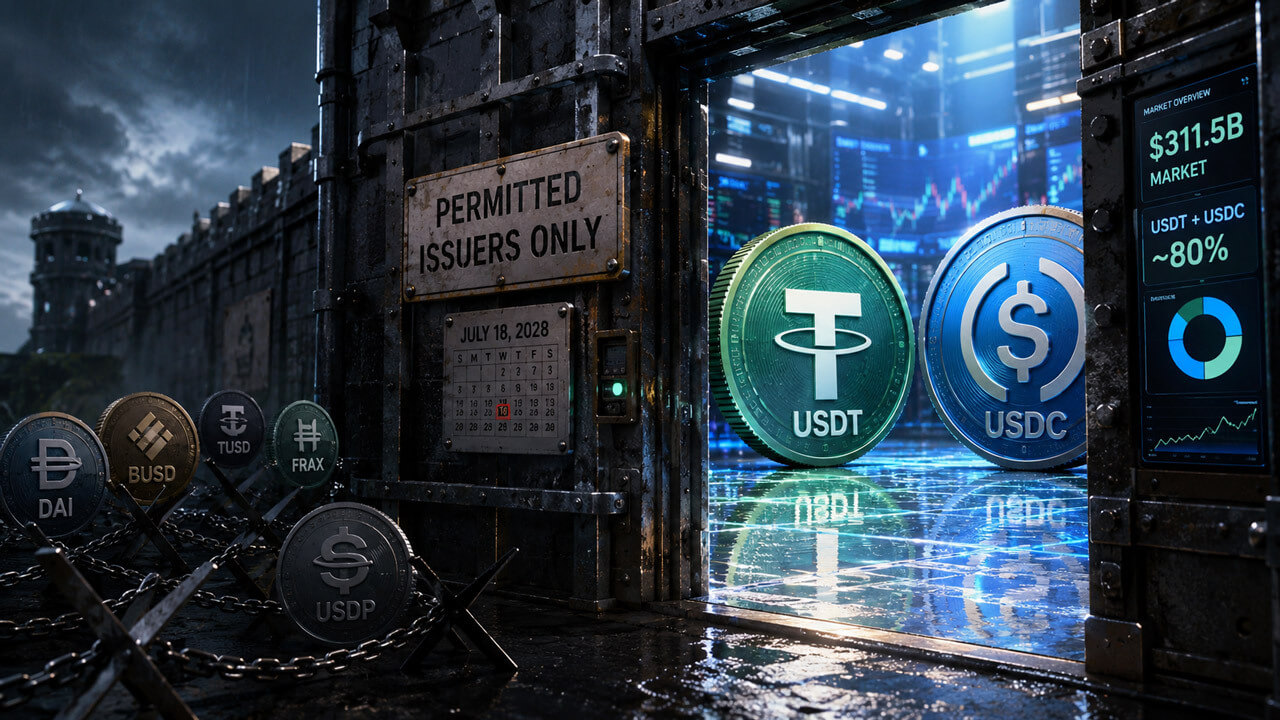
The impending July 18 deadline for the GENIUS Act forces federal regulators to officially categorize which stablecoin issuers are permitted to serve American investors.
The July 18 GENIUS Act deadline marks a critical shift where U.S. regulators must clarify which stablecoin issuers—domestic, foreign, or state-qualified—are legally allowed to operate within the American financial system.
While many headlines focus on price swings, the real infrastructure of the market is changing. On July 18, a pivotal regulatory clock runs out, requiring U.S. authorities to define the boundaries of the stablecoin market. For the average investor in the United States, this isn't about losing access to your funds, but rather about who is allowed to hold the keys to the "digital dollars" (stablecoins) you trade with on platforms like Coinbase or Gemini.
Breaking Down the GENIUS Act Deadline
The GENIUS Act represents a major push toward bringing stablecoins (cryptocurrencies designed to maintain a steady value, usually pegged to the U.S. dollar) into the light. Regulators are now tasked with sorting issuers into three distinct buckets: permitted, foreign, and state-qualified.
This classification process ensures that companies issuing these tokens—often backed by U.S. Treasury bills—are following strict accounting rules. If an issuer cannot prove their reserves, they risk being barred from the American financial ecosystem. According to data from CoinGecko, stablecoins represent a significant portion of the total crypto market cap, making this regulatory clarity vital for overall market health.
"The goal of the GENIUS Act is to provide a transparent framework so that U.S. investors aren't left holding the bag if an offshore stablecoin issuer fails to maintain its dollar peg."
The Three Tiers of Stablecoin Issuers
To understand how this affects your portfolio, you must understand how the government now views these companies. The new framework divides the market to manage risk more effectively:
- Permitted Issuers: These are federally regulated entities that meet the highest standards of transparency and capital requirements.
- State-Qualified Issuers: These companies hold licenses in specific states (like the New York BitLicense) and must prove they meet federal baseline standards.
- Foreign Issuers: Non-U.S. companies that must navigate specific reciprocity agreements to offer tokens to Americans.
Why This Matters for Liquidity
Liquidity (the ease with which you can buy or sell an asset without changing its price) depends on trust. By setting a deadline for these definitions, the U.S. government is essentially creating a "white list" of trusted digital dollar providers.
The Impact on Asset Backing
Most major stablecoins are backed by collateral (assets held in reserve to guarantee value). In the past, some issuers were criticized for holding risky commercial paper. The new rules favor issuers who hold high-quality liquid assets like cash and short-term Treasuries. Investors should expect more frequent attestations (third-party verifications of a company's bank balance) as a result of this deadline.
- Regulatory review of issuer reserves begins.
- Issuers submit compliance documentation to relevant agencies.
- Market makers adjust liquidity based on issuer status.
- Final classifications are recorded to stabilize the U.S. crypto sector.
What This Means for USA Investors
For Americans, this regulatory move is a double-edged sword. On one hand, it increases safety; on the other, it may limit the variety of tokens available on domestic exchanges. The IRS (Internal Revenue Service) continues to view stablecoin-to-crypto trades as taxable events, and this new oversight will likely make it easier for tax authorities to track large-scale transactions through regulated issuers.
If you use Coinbase, Kraken, or Gemini, you likely already use coins that aim for this high level of compliance, such as USDC. However, if you hold offshore tokens like USDT (Tether), you should watch for how these issuers respond to the new federal definitions. If a token is labeled "non-permitted," U.S. exchanges may be forced to delist it to avoid SEC (Securities and Exchange Commission) enforcement actions.
Preparing Your Portfolio for Regulation
As the July 18 milestone passes, the market will likely see a flight to quality. Investors are encouraged to review the transparency reports of the stablecoins they hold. Choosing a fully reserved token that follows U.S. auditing standards can protect you from sudden "de-pegging" events, where a coin loses its $1.00 value. While the GENIUS Act deadline isn't an immediate "shutdown" of crypto, it is the start of a more regulated, and potentially safer, digital dollar era in America.
Key Takeaways
- Clarify which stablecoin issuers meet new U.S. federal standards by the July 18 regulatory deadline.
- Distinguish between U.S.-based, state-chartered, and foreign-permitted stablecoin providers for safety.
- Expect increased oversight on assets backing popular tokens like USDC and USDT to ensure 1:1 parity.
- Prepare for potential shifts in liquidity as non-compliant offshore issuers face tighter U.S. restrictions.