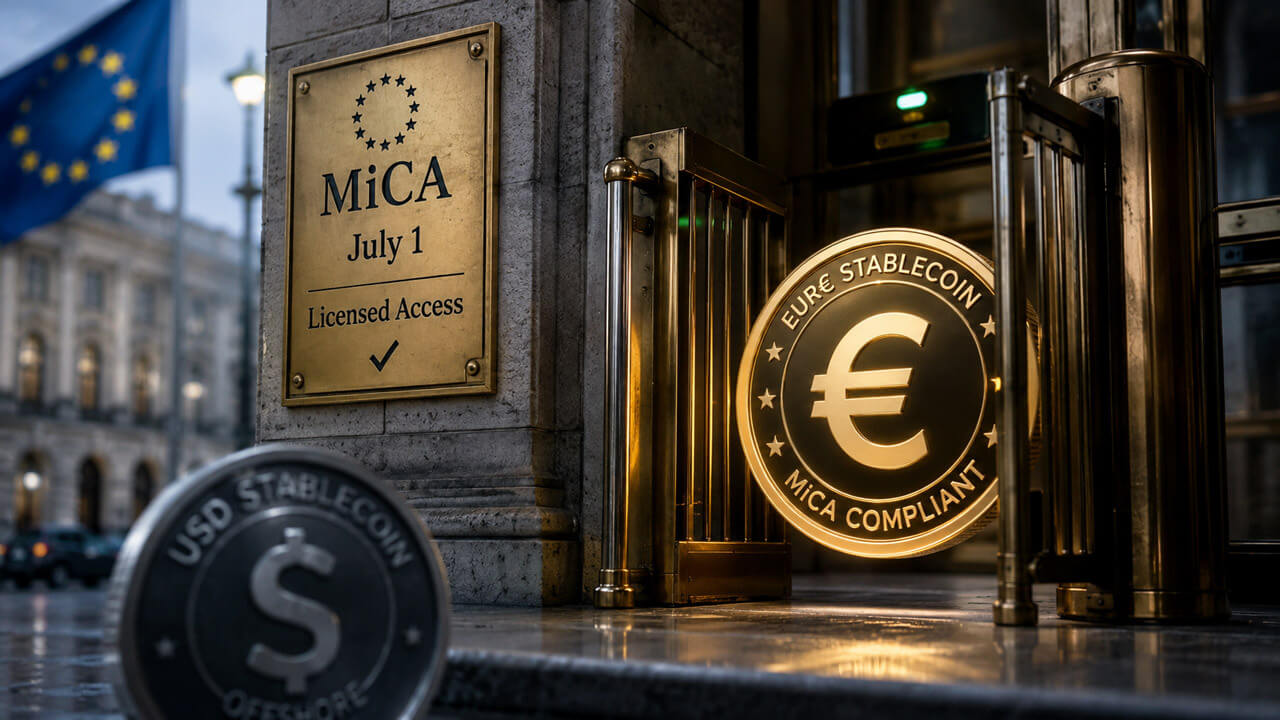
The European Union’s Markets in Crypto-Assets (MiCA) regulation is effectively handing the keys of the stablecoin market to traditional banks by mandating strict capital reserves and licensing paths that favor legacy financial institutions.
The European Union’s MiCA regulation is shifting the balance of power toward traditional banks by imposing strict licensing requirements that favor established financial institutions over independent crypto firms.
As the European Union moves past its initial transition phase for the MiCA framework, a new reality is setting in for the digital asset world. For US investors, this isn't just a foreign policy shift; it is a global benchmark that could dictate how the Securities and Exchange Commission (SEC) views stablecoins (cryptocurrencies pegged to a steady value, usually the US Dollar) moving forward.
The Great Bank Takeover of Stablecoins
Under the new MiCA rules, the barriers to entry for issuing a stablecoin have skyrocketed. The regulation requires issuers of Asset-Referenced Tokens (ARTs) and E-Money Tokens (EMTs) to adhere to stringent liquidity standards. Most notably, issuers must ensure that at least 60% of their reserve assets are held in designated European credit institutions.
This requirement essentially forces crypto-native companies to partner with traditional banks. For decades, the crypto movement sought to "unbank" the world, but MiCA is doing the opposite. By making banks the primary custodians of the collateral that backs stablecoins, the EU is cementing the role of legacy finance in the future of digital payments. This shift ensures that if a stablecoin issuer fails, the underlying fiat currency (government-issued money like the Dollar or Euro) remains protected within the regulated banking system.
"The MiCA framework represents a fundamental pivot from decentralized ideals toward a hybrid model where traditional banking oversight is the price of admission for mass-market crypto adoption."
Impact on Retail Access and Wallets
It is not just about who clears the trades; it is about who controls the interface. MiCA introduces new rules for CASPs (Crypto-Asset Service Providers), which include exchange platforms and digital wallets. These entities must now obtain a specific license to operate across the EU's 27 member states.
Traditional banks are perfectly positioned to capitalize on this. Because banks already hold the necessary banking licenses and maintain deeply rooted trust with retail customers, they are launching their own integrated crypto wallets. According to market data from CoinGecko, the stablecoin market cap remains dominated by US-linked assets, but European bank-issued stablecoins are expected to grow as these regulations take full effect.
- Market Consolidation: Smaller crypto firms may be forced to merge with banks to survive compliance costs.
- Verified ID: Increased KYC (Know Your Customer) requirements will make anonymous transactions nearly impossible in the EU.
- Institutional Onramps: Standardized rules make it safer for pension funds and large corporations to hold stablecoins.
Global Consequences of EU Policy
While these rules are European, their reach is global. Any US-based company wanting to serve European citizens must comply with MiCA. This creates a "Brussels Effect," where EU standards become the de facto global standard. Major US issuers like Circle (the company behind USDC) have already secured French licenses to stay ahead of the curve.
The regulation also creates a tiered system for stablecoins. Significant stablecoins—those with high transaction volumes or a large user base—face even stricter oversight from the European Banking Authority (EBA). This ensures that no single private digital currency can threaten the monetary sovereignty of the Euro or the stability of the regional financial system.
- Issuers apply for authorization from national regulators.
- Internal risk management audits are conducted by the EBA.
- Public disclosures regarding reserve transparency are mandated monthly.
What This Means for USA Investors
For investors in the United States, the EU's move provides a glimpse into the future of domestic regulation. Currently, US-based exchanges like Coinbase and Kraken are navigating a complex web of state-level money transmitter licenses. The success of MiCA may embolden US lawmakers to pass the Lummis-Gillibrand bill or similar stablecoin legislation.
From a tax perspective, the IRS (Internal Revenue Service) treats stablecoins as property. If US regulations follow the MiCA path, we may see more "compliant" stablecoins emerging that are easier to track for tax reporting but offer less privacy. Furthermore, if European banks dominate the stablecoin supply, US investors might face restricted liquidity on offshore platforms that refuse to comply with these high standards, potentially pushing more volume toward regulated US exchanges like Gemini.
The Future of Decentralized Finance (DeFi)
One of the biggest concerns for intermediate investors is how MiCA affects DeFi (Decentralized Finance). While the current MiCA text focuses on centralized issuers, the European Commission is already studying how to regulate purely decentralized protocols. If the "bank-first" approach continues, we may see a split in the market: a fully regulated, bank-backed "Institutional DeFi" and a separate, more volatile "Wild West" DeFi.
Ultimately, MiCA brings legitimacy to the asset class, but it comes at the cost of the permissionless nature of early crypto. US investors should watch the Euro-pegged stablecoin market closely, as it will serve as the first major test case for a fully regulated, bank-integrated digital economy.
Key Takeaways
- Identify how MiCA forces stablecoin issuers to hold 60% of reserves in European bank accounts.
- Recognize the growing influence of traditional banks in the retail crypto wallet and payment space.
- Evaluate the competitive advantage large EU banks now have over smaller, non-compliant crypto startups.
- Monitor how SEC and US lawmakers might use MiCA as a blueprint for future American stablecoin bills.
- Understand the impact of MiCA on global liquidity for pegged assets like USDT and USDC.