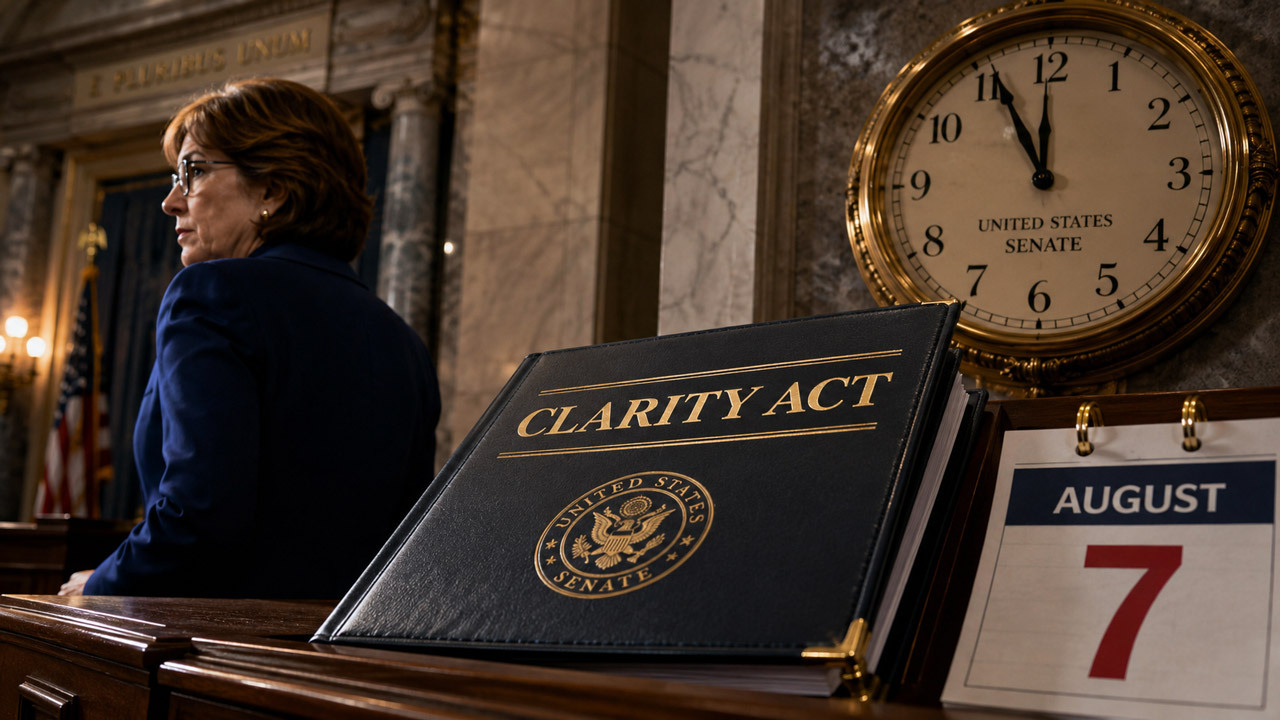
The CLARITY Act has officially missed its July legislative target, leaving the future of US stablecoin regulation hanging on a high-stakes deadline of August 7 before the Senate breaks for summer.
The CLARITY Act, a pivotal US bill aimed at regulating stablecoins, missed its July voting target and now faces a critical legislative deadline on August 7 before the Senate summer recess.
Washington lawmakers are currently in a race against the clock to pass the CLARITY Act, a piece of legislation designed to bring federal oversight to stablecoins (cryptocurrencies pegged to the value of the US Dollar). While proponents hoped for a breakthrough last month, the bill is now entering a narrow window of opportunity.
For American investors, this delay is more than just political theater. Stablecoins serve as the primary on-ramp and off-ramp for the digital asset market, and a lack of clear federal rules keeps the industry in a state of regulatory limbo.
The Deadline Crisis: Why August 7 Matters
The United States Senate is scheduled to begin its August recess shortly, meaning any significant legislation must gain floor time before August 7. If the CLARITY Act remains stuck in committee, it risks losing momentum as the 2024 election cycle takes center stage.
Senate leaders are currently juggling high-priority funding bills alongside digital asset reform. The challenge isn't just a lack of interest, but a lack of time on the legislative calendar to debate complex financial rules.
"The push for stablecoin regulation is no longer about 'if' it will happen, but 'when' the SEC and Treasury Department will finally have a clear framework to enforce."
Understanding the CLARITY Act's Goals
The CLARITY Act stands for "Creating Legal Accountability for Rogers Inconsistent Transformation Yield" (though in practice, it focuses on fiat-backed tokens). The primary goal is to ensure that companies issuing stablecoins actually hold the reserves they claim to have.
Currently, many investors check data on CoinGecko to see the market capitalization and volume of assets like USDC or USDT. However, without a federal law, there is no single US standard for how these reserves are audited or maintained.
- Mandatory Audits: Issuers would need to prove they hold 1:1 liquid reserves.
- Bank-Like Oversight: Some versions of the bill suggest issuers should meet certain capital requirements similar to community banks.
- Federal vs. State Power: A major sticking point remains whether the Federal Reserve or state regulators should have the final word.
What This Means for USA Investors
For crypto users in the United States, the outcome of this bill directly impacts how you interact with Coinbase, Kraken, or Gemini. Federal regulation would likely make stablecoins feel more like traditional bank products, potentially increasing safety but also increasing Know Your Customer (KYC) requirements.
From an IRS perspective, stablecoins are generally treated as property, though their 1:1 peg often means there are no capital gains to report unless the peg "breaks." If the CLARITY Act passes, it would provide a clearer path for the SEC (Securities and Exchange Commission) and CFTC (Commodity Futures Trading Commission) to stop their jurisdictional infighting.
- Tax Stability: Clearer rules help confirm that stablecoin conversions aren't predatory tax events.
- Exchange Access: US-regulated exchanges are more likely to list innovative stablecoins if they have a federal blessing.
- Reduced De-pegging Risk: Federal oversight aims to prevent a repeat of the Terra/Luna collapse of 2022.
The Path Forward: Post-August Outlook
If the August 7 deadline passes without a vote, the bill is unlikely to see movement until the Lame Duck session (the period after the November election but before the new Congress is sworn in). This would leave the US market behind other regions like the European Union, which has already implemented its MiCA framework.
Investors should prepare for continued volatility in the regulatory headlines. Until a bill like the CLARITY Act becomes law, the primary enforcement mechanism in the US will remain "regulation by enforcement"—where the SEC sues companies individually rather than following a set of published rules.
Key Takeaways
- Monitor the August 7 deadline for Senate floor time as it determines the bill's momentum.
- Recognize that the CLARITY Act seeks to establish rules for fiat-backed digital currencies.
- Understand that political gridlock continues to delay regulatory certainty for US crypto users.
- Watch for potential impacts on major USDC and USDT issuers if federal oversight increases.