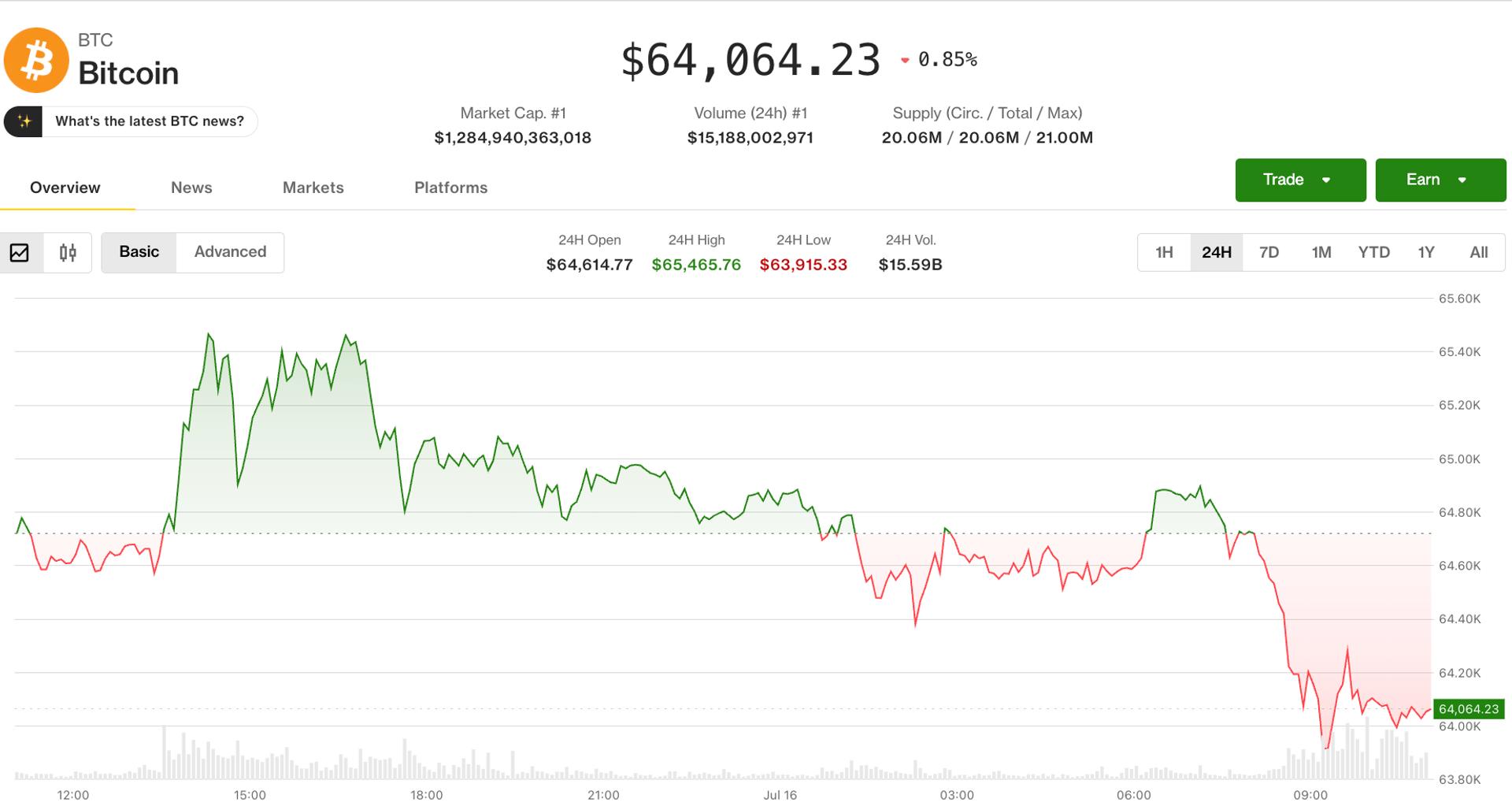
Bitcoin has retreated to the $64,000 support zone following a brief rally to a monthly high of $65,500, as traders lock in gains and global tensions spook investors.
Bitcoin fell back to the $64,000 level after failing to hold its monthly high of $65,500, triggered by a combination of investor profit-taking and rising geopolitical tensions affecting global markets.
The leading cryptocurrency faced a sharp rejection at overhead resistance levels this week. For American investors, this move represents a common 'cooling off' period after a period of intense buying. The price action was influenced by a mix of technical sell orders and external macro factors that shifted the mood from greed to caution across US trading desks.
The Rejection at $65,500 Resistance
Bitcoin's attempt to break out past $65,500 was short-lived as 'bears' (investors who expect prices to fall) took control of the narrative. This specific price point acted as a ceiling, where many large-scale holders decided to sell their BTC (the ticker symbol for Bitcoin) to realize profits made during the recent climb.
When a significant number of sell orders hit the books simultaneously, it creates downward pressure. Many retail traders in the US saw their stop-loss orders triggered, which accelerated the slide back toward the $64,000 mark. This level is now seen as a critical psychological support floor.
Geopolitical Tension Impacts Crypto Markets
While crypto is often called 'digital gold,' it frequently trades like a 'risk-on' asset (an investment people sell when they are nervous about the world). Recent news of strikes on US bases coincided with the price drop, causing a flight to safety in traditional markets like the US Dollar and actual gold.
"Geopolitical instability creates an immediate 'sell-first, ask-questions-later' environment in the liquid crypto markets, even if the long-term thesis for Bitcoin remains unchanged."
According to data from CoinGecko, the total crypto market capitalization saw a noticeable dip as Altcoins (alternative coins other than Bitcoin) followed BTC's lead downward. This correlation shows how sensitive the digital asset market remains to US foreign policy and international conflict.
Technical Indicators for US Traders
Market analysts are currently watching several key indicators to see if this is a temporary dip or the start of a deeper correction. The Relative Strength Index (a momentum tool measuring the speed of price changes) suggests that Bitcoin was 'overbought' when it hit $65,500, making a pullback healthy for long-term growth.
- Support Zone: Buyers are expected to defend the $62,500 to $64,000 range.
- Volume: Trading volume on US exchanges like Coinbase has spiked during the sell-off.
- Liquidations: Over $150 million in 'long' positions (bets that the price will go up) were wiped out in 24 hours.
What This Means for USA Investors
For investors based in the United States, this price action has specific implications for tax and portfolio management. Since the IRS (Internal Revenue Service) treats Bitcoin as property, every time you sell for a profit—even during a dip—you trigger a capital gains tax event.
- Tax-Loss Harvesting: If you bought near the $65,000 peak, you might eventually use a dip to offset other gains.
- Exchange Stability: Major US platforms like Kraken and Gemini remained operational during the volatility, though spreads may widen.
- Regulatory Eye: The SEC (Securities and Exchange Commission) continues to monitor market volatility as they evaluate further crypto-related financial products.
Most US-regulated exchanges report that USD-paired trading remains the dominant way investors enter the market, meaning the strength of the dollar continues to play a massive role in Bitcoin’s local price performance.
Looking Ahead: Recovery or Further Slide?
The coming days will be vital for Bitcoin's trajectory. If the $64,000 level holds, we may see a period of 'consolidation' (sideways trading) before another attempt at the $66,000 mark. However, if the price breaks below $63,000, it could signal a shift in the medium-term trend.
Investors should stay alert to US economic data releases, such as inflation reports, which often dictate how much liquidity is available for speculative assets like crypto. For now, the 'bears' have the upper hand, but the market remains highly reactive to sudden news shifts.
Key Takeaways
- Monitor the $64,000 support level as Bitcoin faces increased selling pressure from short-term traders.
- Watch geopolitical developments closely, as Middle East tensions often trigger 'risk-off' moves in crypto.
- Anticipate continued volatility in the short term as the market digest recent monthly gains.
- Evaluate long-term hold strategies versus short-term trading in response to sudden 2% price swings.