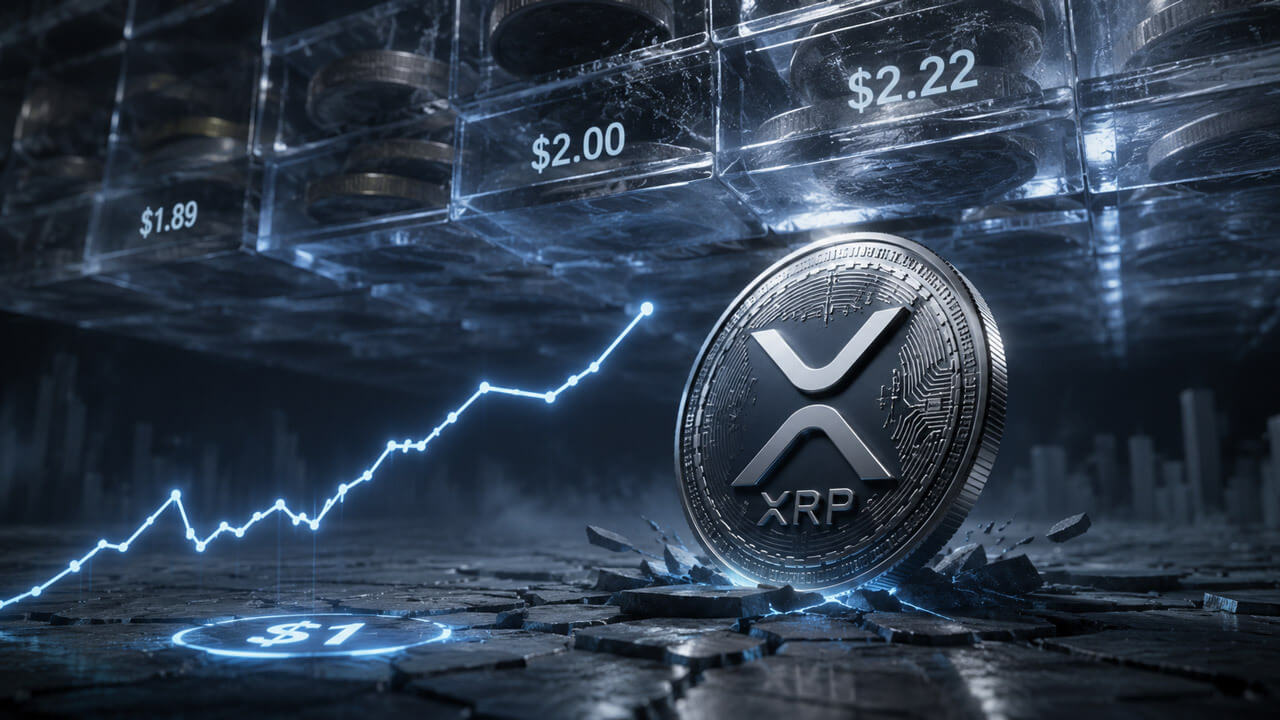
XRP's climb back to the $1 milestone is a psychological victory, but technical data suggests a massive 'supply wall' exists at the $2.22 level where many investors are currently 'underwater' on their positions.
While XRP has successfully rebounded to the $1 level, it faces significant selling pressure from long-term holders with an average buy-in cost of $2.22.
The digital asset market is currently witnessing a tug-of-war between new buyers and legacy holders. For American investors watching XRP (the native token of the Ripple network), the recent push above $1 marks a significant recovery from previous lows. However, on-chain data reveals that a large percentage of holders who entered the market 6 to 12 months ago are still facing unrealized losses. This demographic bought in at an average cost basis (the original value of an asset for tax purposes) of $2.22, which is roughly 52% higher than the current trading price of $1.08.
The $2.22 Resistance Level Explained
In technical analysis, a 'supply wall' often forms at the price levels where investors originally bought their tokens. When the price returns to that level, these'trapped' investors often sell to break even (exit a trade with no profit or loss). This creates significant selling pressure that can stall a rally.
Data from blockchain analytics firms shows a distinct divide between different classes of holders:
- Short-term holders: Those who bought in the last 30 days have a realized price (the average price coins last moved at) of $1.09 to $1.11.
- Mid-term holders: Those holding for 6-12 months are averaging a $2.22 entry point.
- Long-term whales: Large accounts that have held through multiple cycles typically have much lower cost bases.
"The gap between the $1 floor and the $2.22 ceiling represents a zone of uncertainty where profit-taking and 'break-even' selling will likely collide."
Funding Rates and Market Sentiment
While the price struggles with these overhead levels, the derivatives market (contracts that derive value from an underlying asset) shows a neutral stance. Perpetual funding rates—the periodic payments made between long and short traders to keep contract prices aligned with the spot price—have remained stable.
A stable funding rate suggests that the market is not overly 'leveraged' or 'hyped.' This is generally healthy for sustained growth, as it prevents the 'long squeezes' often seen during parabolic moves. You can track real-time market shifts and global volume for Ripple on CoinGecko to see if buying pressure is increasing enough to absorb the expected selling at $2.
Navigating the Current XRP Volatility
For those looking to enter or exit positions, understanding the liquidity (the ease with which an asset can be converted to cash) is vital. Currently, XRP sits in a consolidation phase. To confirm a true 'bull run,' the price needs to flip the $1.11 level from resistance into support.
- Watch for high volume: A breakout above $1.20 supported by high trading volume suggests new buyers are overpowering the trapped sellers.
- Monitor Bitcoin's movement: As the market leader, Bitcoin often dictates the direction of Altcoins (any cryptocurrency that is not Bitcoin).
- Stay updated on legal news: Ripple's ongoing regulatory status continues to influence investor confidence more than technical charts alone.
What This Means for USA Investors
For US-based investors, the $2.22 level isn't just a technical marker; it is a major tax consideration. Under IRS guidelines, selling XRP at $1.08 when you bought it at $2.22 would trigger a capital loss, which can be used to offset other capital gains or up to $3,000 of ordinary income. Check your transaction history on major US exchanges like Coinbase, Kraken, or Gemini to determine your specific cost basis.
Regulatory and Exchange Context in America
The SEC (Securities and Exchange Commission) posture toward Ripple remains a central theme for American portfolios. While XRP is widely available on major US platforms again, the legal clarity regarding secondary market sales is what allows institutional investors to participate. Furthermore, since XRP is traded against the USD, any strengthening of the US Dollar Index (DXY) could weigh on the token's ability to reach that $2.22 target.
If you are holding XRP in a self-custody wallet, ensure you are tracking your USD-equivalent value at the time of each trade for accurate tax reporting. The path to $2 remains open, but it will require significant market capitalization (the total dollar value of all coins in circulation) growth to clear the hurdle of underwater holders looking for an exit.
Key Takeaways
- Identify $2.22 as the critical 'break-even' point where many long-term holders may sell.
- Monitor $1.08 as the immediate support floor for current price action.
- Analyze the 52% gap between current prices and the average cost basis of year-long holders.
- Evaluate the impact of neutral funding rates on potential upcoming volatility.
- Consider the tax implications of selling XRP at a loss versus holding for long-term gains.