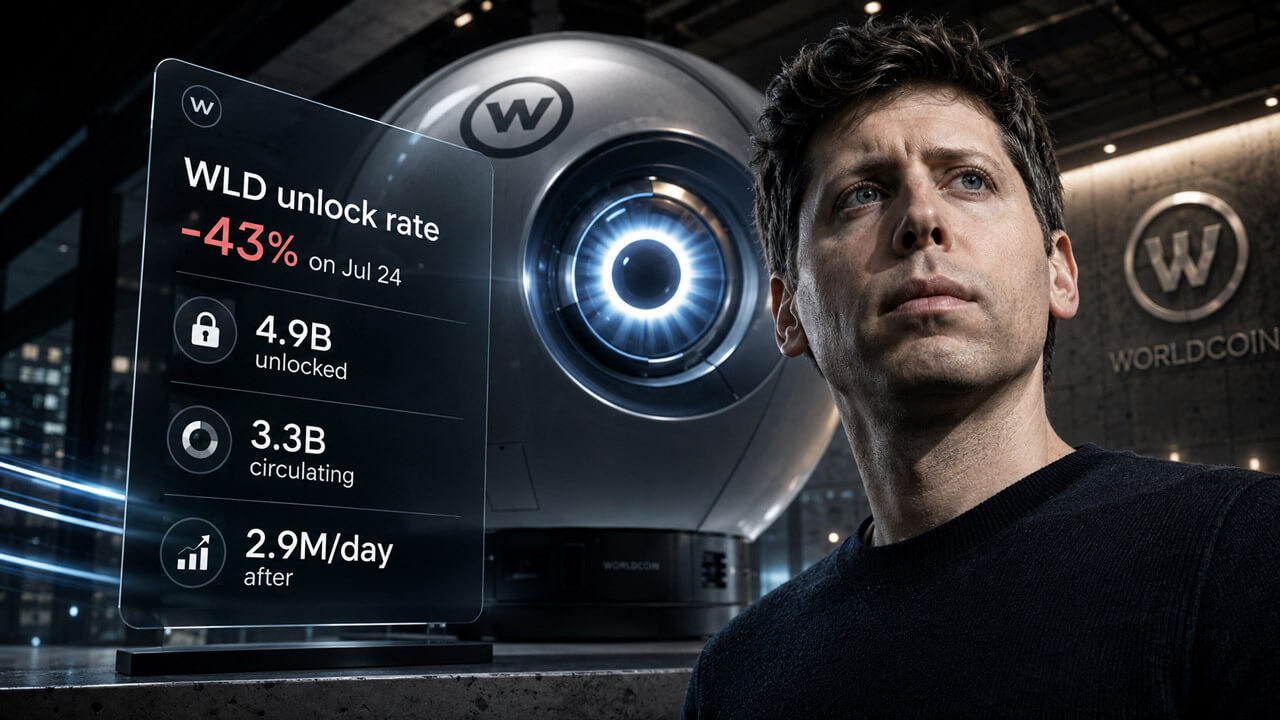
Worldcoin has formally adjusted its tokenomics by slowing down the daily release of WLD tokens by 43%, a move designed to reduce immediate inflationary pressure on the asset.
Worldcoin is officially extending its token unlock schedule, reducing daily WLD emissions by 43% to slow down the entry of new tokens into the market.
The project, co-founded by OpenAI CEO Sam Altman, announced a significant change to how early contributors and investors receive their coins. By stretching out the distribution timeline, the team aims to prevent a massive price drop that often occurs when a "cliff" (a sudden release of previously locked tokens) hits the open market.
For American investors watching the altcoin (any cryptocurrency other than Bitcoin) space, this move highlights the delicate balance between rewarding early backers and keeping the price stable for new buyers. The change officially kicks in on July 24, affecting billions of dollars in projected market value.
Understanding the 43% Cut in Token Emissions
At its core, Worldcoin is lengthening the "vesting schedule" (the timeline during which locked tokens become available to sell) for its team and investors. Previously, these tokens were set to unlock linearly over three years. Under the new plan, that window has been extended to five years.
This means that rather than flooding the market with a high volume of WLD daily, the tap is being turned down. According to data tracked by CoinGecko, managing this circulating supply is vital for projects with high "FDV" (fully diluted valuation, which is the total value if all possible tokens were in circulation).
The team noted that nearly half of the total supply was already circulating by early 2024. However, the looming threat of billions of new tokens hitting the market had kept many cautious investors on the sidelines.
Why Token Unlocks Matter for Your Portfolio
When a crypto project "unlocks" tokens, it increases the circulating supply. In basic economic terms, if demand stays the same but supply increases significantly, the price per token usually drops.
- Market Dilution: More tokens in circulation make each individual token less rare.
- Venture Capital Exits: Early investors often sell their tokens immediately upon unlocking to realize profits.
- Price Volatility: The days leading up to and following an unlock are typically characterized by high price swings.
By cutting the daily emission rate, Worldcoin is attempting to "smooth the curve." They are betting that a slower release will allow the market to absorb the new tokens without crashing the price of WLD.
The 4.9 Billion Token Question
Despite the slower schedule, the math remains daunting. There are still approximately 4.9 billion WLD tokens waiting to enter the market over the coming years. This creates a "supply overhang" where the market knows a large amount of selling pressure is inevitable.
"The primary challenge for Worldcoin isn't just the supply side; it is proving that there is enough demand for 'World ID' and biometric verification to offset the billions of tokens coming online."
For the price to move upward significantly, Worldcoin must prove that its Orb-based scanning technology has a utility that people are willing to pay for. Without real utility, the token remains a speculative asset backed primarily by the fame of its founders.
What This Means for USA Investors
For those trading in the United States, Worldcoin remains a complex asset. While the WLD token is not officially available on US-based versions of Coinbase or Kraken due to regulatory uncertainty, many US residents follow the project because of Sam Altman's influence on the AI sector.
- IRS Tax Treatment: If you are a US taxpayer who acquired WLD abroad or via DeFi, every sell or swap is a taxable event subject to Capital Gains taxes.
- SEC Posture: The SEC (Securities and Exchange Commission) has been aggressive toward tokens that held private sales for investors, which could impact Worldcoin's long-term US availability.
- Dollar Valuation: As WLD is paired against the US Dollar (USD) on global exchanges, its price is sensitive to US interest rate hikes and inflation data.
Currently, the SEC has not specifically targeted Worldcoin, but the project's biometric data collection has raised eyebrows among US privacy advocates and state-level regulators in places like California and New York.
Navigating the Future of WLD
The decision to slow down unlocks is generally seen as a "bullish" (price-positive) move in the short term, but it does not change the long-term reality of the project's massive supply. Investors should monitor the token's market cap (total market value) rather than just the price per coin.
If you are an intermediate investor, the key is to watch for "real-world adoption" metrics. If the number of people using World ID grows faster than the 4.9 billion tokens are released, the price may find a floor. If adoption stalls while the 43%-reduced supply continues to drip into the market, the downward pressure will likely continue.
Key Takeaways
- Reduce daily token emissions by 43% starting July 24 to ease market sell pressure.
- Extend the original three-year vesting period for early contributors to five years.
- Address the massive 4.9 billion token overhang that remains to be distributed.
- Manage long-term supply inflation to attract more stable, intermediate investors.
- Highlight the ongoing challenge of matching massive supply with real-world demand.