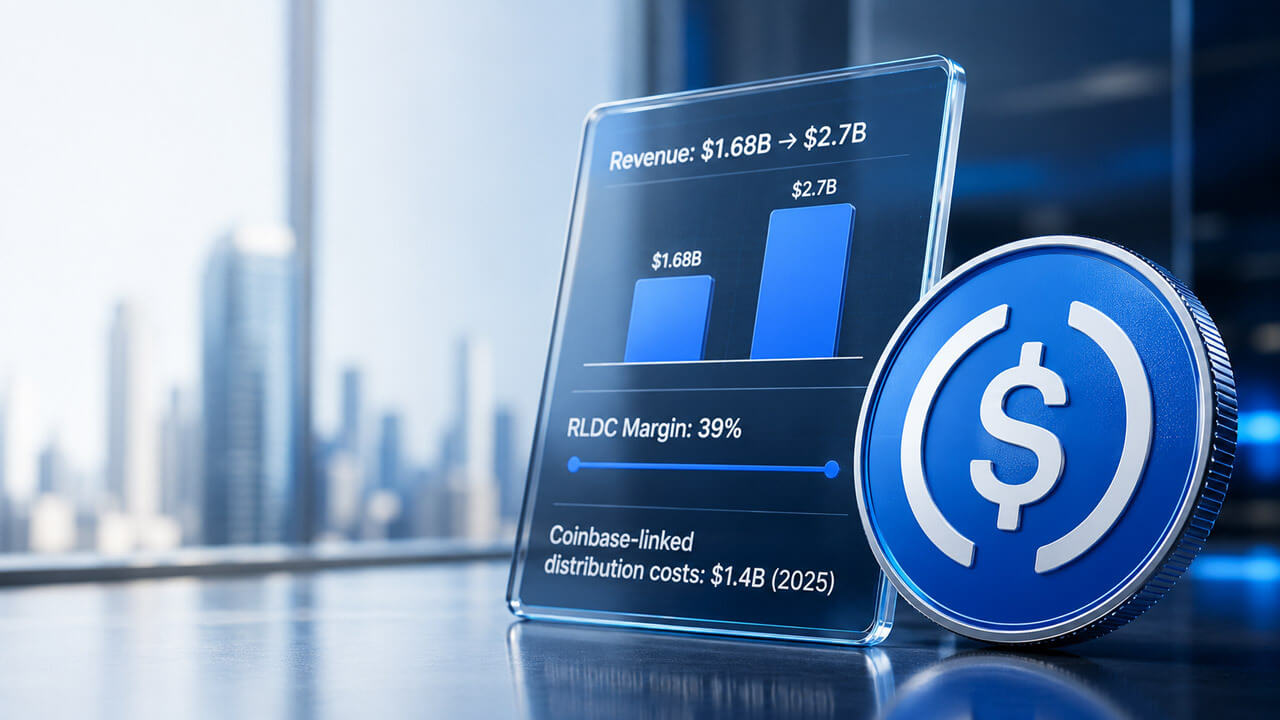
Circle is paying a high price for USDC’s massive growth, spending over $1.4 billion to keep its stablecoin at the top of the American crypto market.
USDC circulation surged 72% reaching $75.3 billion, yet Circle paid over $1.4 billion in distribution costs to partners like Coinbase, nearly doubling its expenses to maintain market dominance.
Circle, the Boston-based issuer of USD Coin (USDC), recently disclosed a significant jump in the circulation of its flagship digital asset. In late 2024 and early 2025, USDC usage grew by 72%, reaching a massive market cap of $75.3 billion. While these numbers suggest total market dominance, a closer look at the company's financial filings reveals a major catch for the US-based firm.
To keep USDC (a digital token pegged 1:1 to the US dollar) liquid and available on major platforms, Circle is paying huge sums to its partners. Most notably, the company is sharing a massive portion of its income with Coinbase, the largest cryptocurrency exchange in the United States. This trend highlights the expensive reality of operating a regulated stablecoin in today's competitive landscape.
The Cost of Being Number Two
The stablecoin market is a battle for liquidity—the ability to buy or sell an asset without causing a price change. According to Circle's 10-K filing, distribution costs rose to $1.4 billion in 2025. This is a sharp increase from the $924.5 million spent just one year prior. These costs represent the fees Circle pays to ensure USDC remains the preferred choice for traders.
These distribution expenses now consume roughly 51% of Circle's total revenue and interest income from its reserves. Effectively, for every dollar Circle earns from holding the cash that backs USDC, half of it goes right back out the door to partners. This revenue-sharing model is essential for keeping USDC integrated into the CoinGecko listed markets where US investors trade daily.
The Coinbase Connection
Coinbase is not just a partner; it is a co-founder of the Centre Consortium that originally launched USDC. Because so many Americans use Coinbase to buy their first crypto, Circle relies on the exchange to promote USDC over competitors. This relationship is a double-edged sword: it guarantees high volume but costs Circle a fortune in shared interest income.
Why Circulation Is Surging Now
The 72% surge in USDC circulation is driven by several factors relevant to the American economy. First, as the Federal Reserve maintained higher interest rates, the yield on the Treasury bills backing USDC became more attractive. Institutional investors often prefer USDC because it is seen as a "flight to quality" during times of market volatility.
Secondly, the increase in decentralized finance (DeFi) activity—financial services like lending and borrowing that operate on a blockchain without traditional banks—has fueled demand. USDC is frequently used as the primary "cash" element in these automated protocols. This creates a cycle where more usage leads to more circulation, even if the profit margins for Circle are thinning.
"The surge in circulation to $75.3 billion proves USDC is the stablecoin of choice for regulated entities, even as the cost to maintain that infrastructure doubles."
Understanding the Competitive Landscape
Circle isn't just fighting for market share; it's fighting a war on multiple fronts. Its primary competitors include:
- Tether (USDT): The global leader in volume, though it faces more regulatory scrutiny in the US.
- PayPal USD (PYUSD): A newer entrant from the payments giant targeted at retail shoppers.
- Yield-bearing stables: New tokens that pass interest directly to the user rather than the issuer.
- Circle collects USD from users and issues USDC.
- Circle invests that USD in safe assets like US Treasury Bills.
- Circle earns interest on those T-Bills.
- Circle shares that interest with distributors like Coinbase to keep USDC prominent.
What This Means for USA Investors
For the average American crypto investor, USDC remains one of the most accessible and transparent options. Because Circle is a US-incorporated company based in Boston, it adheres to high standards of financial reporting. This makes USDC a popular choice for those using Coinbase, Kraken, or Gemini.
From a tax perspective, the IRS generally views stablecoins as property. However, because USDC is pegged to the dollar, moving from USD to USDC typically does not trigger a significant capital gain or loss. Still, any interest earned through lending your USDC is considered taxable income. As the SEC (Securities and Exchange Commission) continues to scrutinize the crypto industry, Circle's commitment to filing 10-K reports provides a level of transparency that many offshore competitors lack.
Looking Ahead: The Path to IPO
Circle has long hinted at becoming a public company on the US stock market. To do this, they must prove that their business model is sustainable despite the high distribution costs. If they can reduce the percentage of revenue paid to partners while maintaining their 72% growth rate, they could become one of the most profitable firms in the industry.
For now, US investors should view the 72% jump as a sign of market health and trust in the USDC ecosystem. While the "expensive truth" behind their dominance might worry accountants, it ensures that USDC remains the most liquid digital dollar available to the American public.
Key Takeaways
- Monitor USDC's 72% circulation growth as it nears a $75 billion market cap.
- Evaluate the impact of Circle's $1.4 billion payment to Coinbase on its overhead.
- Analyze how 51% of Circle's revenue is now consumed by distribution costs.
- Understand the shifting competition between USDC and other USD-pegged tokens.
- Assess the stability of USDC reserves in a high-interest rate environment.