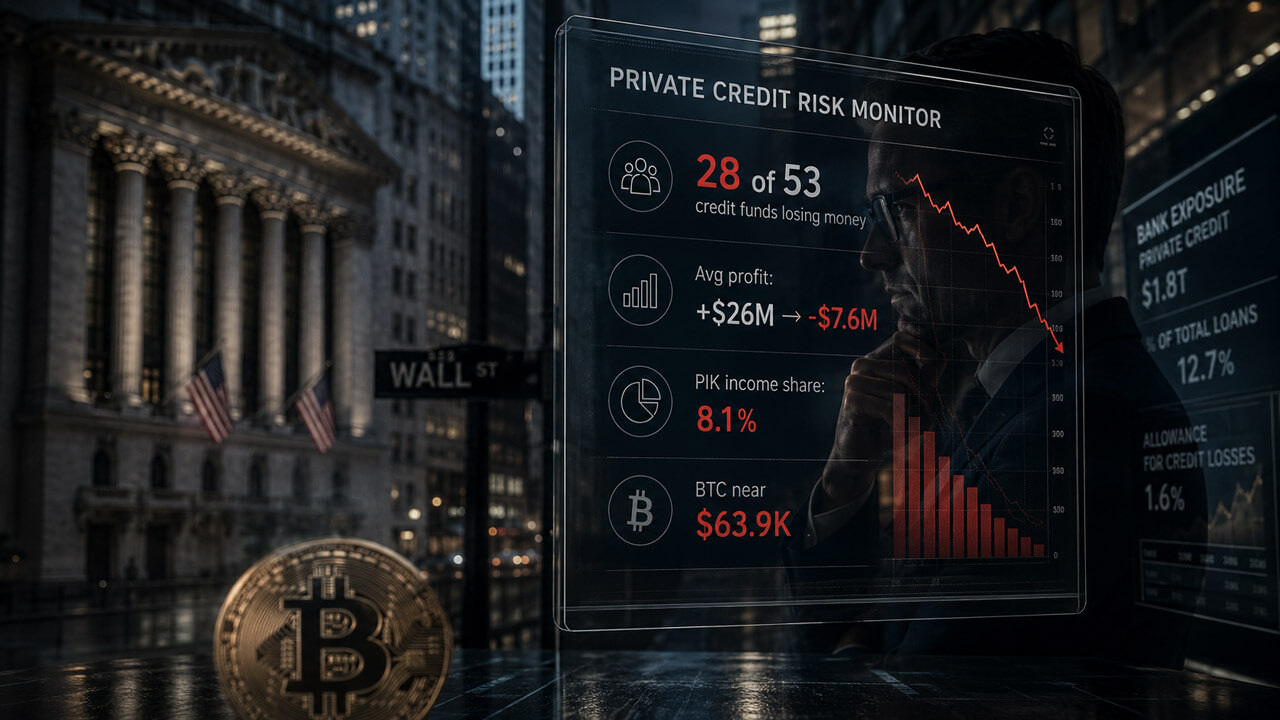
The $1.8 trillion private credit market, often called 'shadow banking,' is showing cracks as 52% of tracked funds report losses, potentially draining liquidity from US crypto markets.
Wall Street's $128 billion private credit exposure is showing signs of moderate stress, with over half of tracked funds reporting losses, potentially tightening liquidity for risk assets like Bitcoin.
As of late 2024, Wall Street's massive exposure to private credit (loans made by non-bank financial institutions) is coming under intense scrutiny. US investors are increasingly worried that a default wave in under-regulated lending sectors could trigger a flight to safety. This migration usually hurts 'risk-on' assets like Bitcoin and Ethereum, as institutional players pull back capital to shore up balance sheets.
The $128 Billion Exposure Reality Check
While industry titans like Jamie Dimon of JPMorgan Chase suggest the risk is contained, the data tells a more nuanced story. At its core, private credit consists of loans made directly to companies by investment firms rather than traditional banks. This market has ballooned to roughly $1.8 trillion, operating largely outside the strict reach of the Federal Reserve.
Recent reports indicate that approximately $128 billion of this exposure is currently sitting in funds that are struggling to break even. For the average American investor, this matters because these lenders often provide the secondary liquidity that supports institutional trading on platforms like Coinbase and Kraken. If these lenders freeze up, the entire financial plumbing of the US markets could slow down.
Why Private Credit Losses Impact Crypto
When Wall Street loses money in niche credit markets, the effects are rarely localized. We often see a phenomenon known as a liquidity crunch (a situation where cash becomes difficult to obtain quickly). In these scenarios, institutions sell their most liquid assets—often Bitcoin—to cover losses in their private loan portfolios.
- Asset Correlation: During times of high credit stress, crypto often trades in lockstep with legacy finance.
- Deleveraging: Investors may close out long positions (bets that prices will go up) to pay off high-interest private debt.
- Risk Aversion: New capital inflows from US pension funds into spot Bitcoin ETFs may slow down.
According to data from CoinGecko, crypto market volatility remains sensitive to broader macroeconomic shifts, particularly those involving US dollar liquidity and corporate debt health.
"You have to have very large losses in private credit before it looks like banks are going to get hit," noted one top banking executive, highlighting that while the 'too big to fail' banks are safe, smaller investment vehicles are not.
A Deep Dive into Fund Performance
Of the 53 major credit funds tracked in recent industry audits, a staggering 28 are currently losing money. This is a sharp reversal from the low-interest-rate era where private credit was considered a 'safe' way to earn high yields. The Federal Reserve’s decision to keep interest rates elevated has made it harder for companies to pay back these private loans.
How a credit crisis typically unfolds:
- Borrowers struggle to pay back floating-rate loans (loans where interest changes over time).
- The private credit fund reports a drawdown (a peak-to-trough decline in investment value).
- Investors in the fund demand their money back, forcing the fund to sell other assets.
- Financial markets experience a 'contagion' effect where selling spreads to unrelated sectors like tech and crypto.
What This Means for USA Investors
For US-based crypto participants, the private credit situation is a reminder of the importance of counterparty risk (the chance that the other party in a deal defaults). While the SEC (Securities and Exchange Commission) continues to regulate crypto exchanges, they have less visibility into the private credit world.
From a tax perspective, the IRS treats crypto losses and gains distinctly, but market crashes triggered by Wall Street credit events are treated the same as any other volatility. Investors using US-regulated exchanges like Gemini or Coinbase should monitor stablecoin de-pegging risks if major credit providers face insolvency. Currently, the USD price of Bitcoin remains the primary 'canary in the coal mine' for measuring how much stress is leaking from Wall Street into the digital economy.
Looking Ahead: Systemic Risk or Managed Correction?
The debate continues over whether this is a localized issue or a systemic threat. If the $128 billion in 'at-risk' credit remains contained, crypto may decouple and resume its upward trajectory. However, if the defaults accelerate, the crypto market could face a 'black swan' event similar to previous financial cycles.
Key Indicators to Watch
American investors should keep an eye on the yield curve and corporate default rates. If private credit funds begin halting withdrawals, it is a significant red flag for all risk assets. Maintaining a diversified portfolio and understanding the link between corporate debt and crypto liquidity is essential for surviving the current transition period in global finance.
Key Takeaways
- Monitor the $1.8 trillion private credit market for potential systemic spillovers into digital assets.
- Recognize that 28 out of 53 major credit funds are currently operating at a loss.
- Prepare for potential 'margin call' scenarios where institutions sell liquid crypto assets to cover debts.
- Observe JP Morgan's cautious stance as Jamie Dimon downplays immediate systemic risks to big banks.
- Evaluate US-based exchange liquidity as institutional capital becomes more risk-averse.