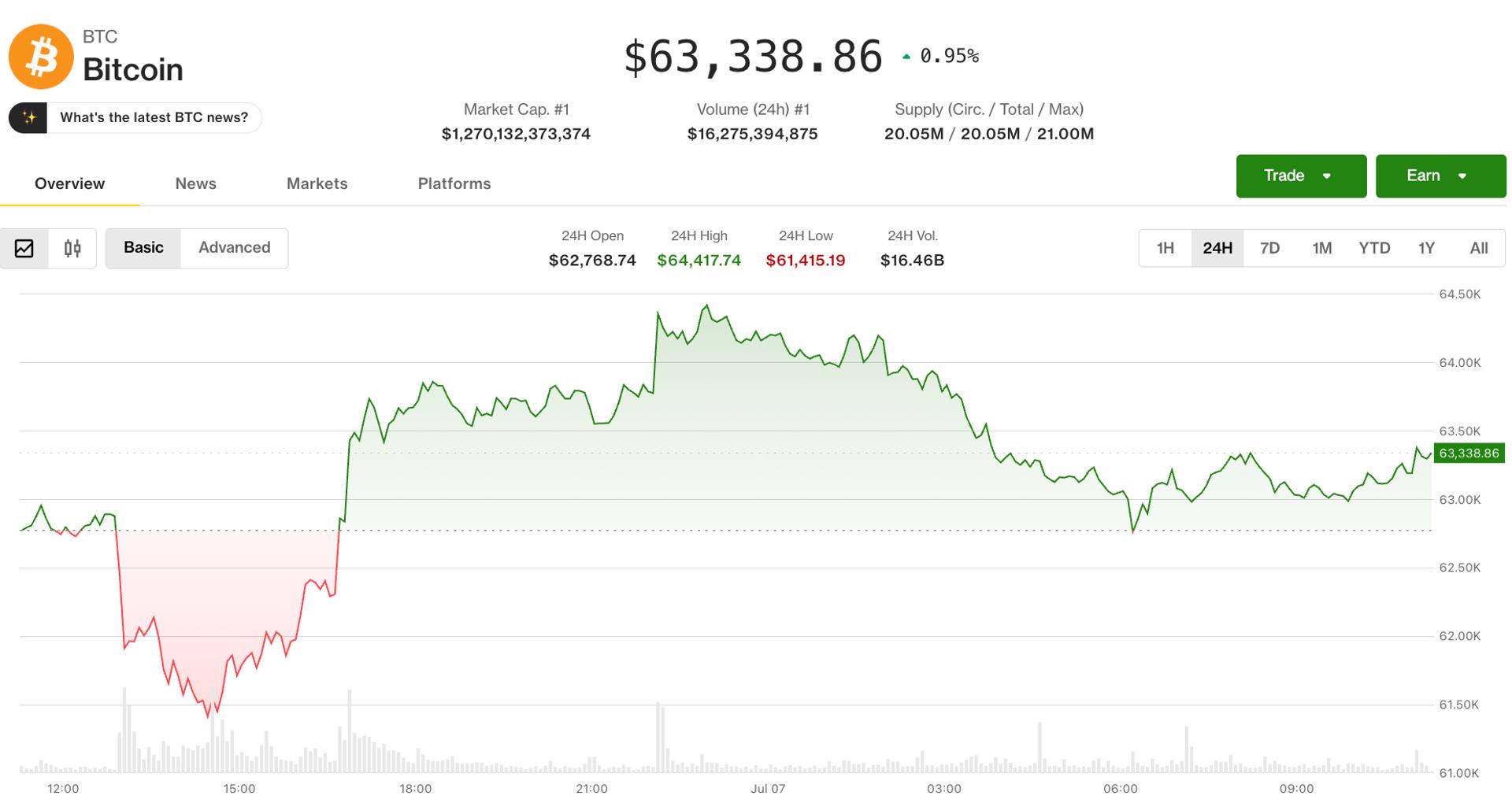
Bitcoin's recent momentum has hit a significant roadblock near the $64,500 mark as a decline in market participation suggests the current rally may be losing steam.
Bitcoin's recent climb to $64,500 has slowed down as declining open interest and low demand from spot buyers suggest the July rally might be losing its momentum.
Mainstreet investors in the United States are watching closely as Bitcoin (BTC) retreated from its two-week high this week. While the primary cryptocurrency saw an impressive 8.4% gain throughout early July, new data indicates that the fuel behind this move might be running dry. For US-based holders using platforms like Coinbase or Kraken, this pause raises questions about whether to buy the dip or wait for further consolidation.
Understanding the Decline in Open Interest
The primary driver behind the recent price stagnation is a drop in open interest (the total number of outstanding derivative contracts, like futures or options, that have not been settled). When open interest falls alongside a price plateau, it often suggests that traders are closing their positions rather than opening new ones.
This reduction in leverage indicates that the "aggressive" money—traders betting on quick price swings—is stepping to the sidelines. For the average American investor, this suggests a transition from a speculative frenzy to a more cautious market environment. Without new money entering these contracts, the price lacks the necessary "push" to break through previous resistance levels.
The Role of Spot Demand in Price Stability
While futures markets drive short-term volatility, spot demand (the actual purchase of Bitcoin for immediate delivery and long-term holding) provides the foundation for sustainable growth. Recent data from CoinGecko shows that while prices remain higher than last month, the volume of actual coins changing hands has softened.
Weak spot demand is often a warning sign for bulls (investors who expect prices to rise). If retail investors in the US are not actively buying BTC at the $64,000 level, the price relies entirely on institutional derivatives to stay afloat. Currently, that support seems to be wavering as buyers wait for a more attractive entry point.
Current Market Sentiment Indicators
- Reduced Trading Volume: Lower activity on major US exchanges indicates a "wait and see" approach.
- Neutral Funding Rates: This suggests neither buyers nor sellers are currently dominant in the market.
- Macroeconomic Uncertainty: US investors are likely waiting for clearer signals on inflation and Federal Reserve interest rate moves.
Historical Context of July Rallies
Bitcoin's 8.4% advance in July follows a period of significant pressure from government sell-offs and mining liquidations. Historically, a strong start to a month can lead to a "mid-month exhaustion" phase where the market takes a breather to find a new floor.
"A decline in open interest during a price retracement is often a healthy sign of a market 'flushing out' excess leverage, but it requires a resurgence in spot demand to resume an upward trajectory."
This cooling-off period is not necessarily a bearish (downward) signal, but rather a reset. It allows HODLers (a crypto term for long-term investors who refuse to sell) to accumulate more assets at a stable price before the next potential leg up.
What This Means for USA Investors
For investors based in the United States, this price action has specific implications for portfolio management and legal compliance. Whether you are trading on Gemini or holding in a cold wallet, the current stall is a good time to review your strategy.
- IRS Tax Treatment: Every trade is a taxable event. If you are selling now to capture the 8.4% gain, remember that short-term capital gains taxes apply if you held the asset for less than a year.
- SEC and CFTC Posture: With Bitcoin clearly defined as a commodity by US regulators, the current price stalling is viewed as natural market cycle behavior rather than a regulatory red flag.
- Exchange Availability: US investors have the advantage of highly regulated exchanges. If spot demand remains low, watch for "buy walls" on Coinbase Pro to see where big US buyers are setting their limit orders.
While the rally has paused, the long-term outlook for US investors remains tied to broader economic health and the eventual cooling of US dollar strength. For now, the $64,500 level remains the hurdle to clear for the next bull run.
Key Takeaways
- Monitor the $64,500 resistance level as it currently acts as a psychological ceiling for Bitcoin buyers.
- Track open interest data to determine if institutional money is entering or exiting the futures market.
- Observe spot demand on major US exchanges like Coinbase to gauge retail investor sentiment.
- Prepare for potential volatility by reviewing long-term cost basis strategies for IRS tax reporting.