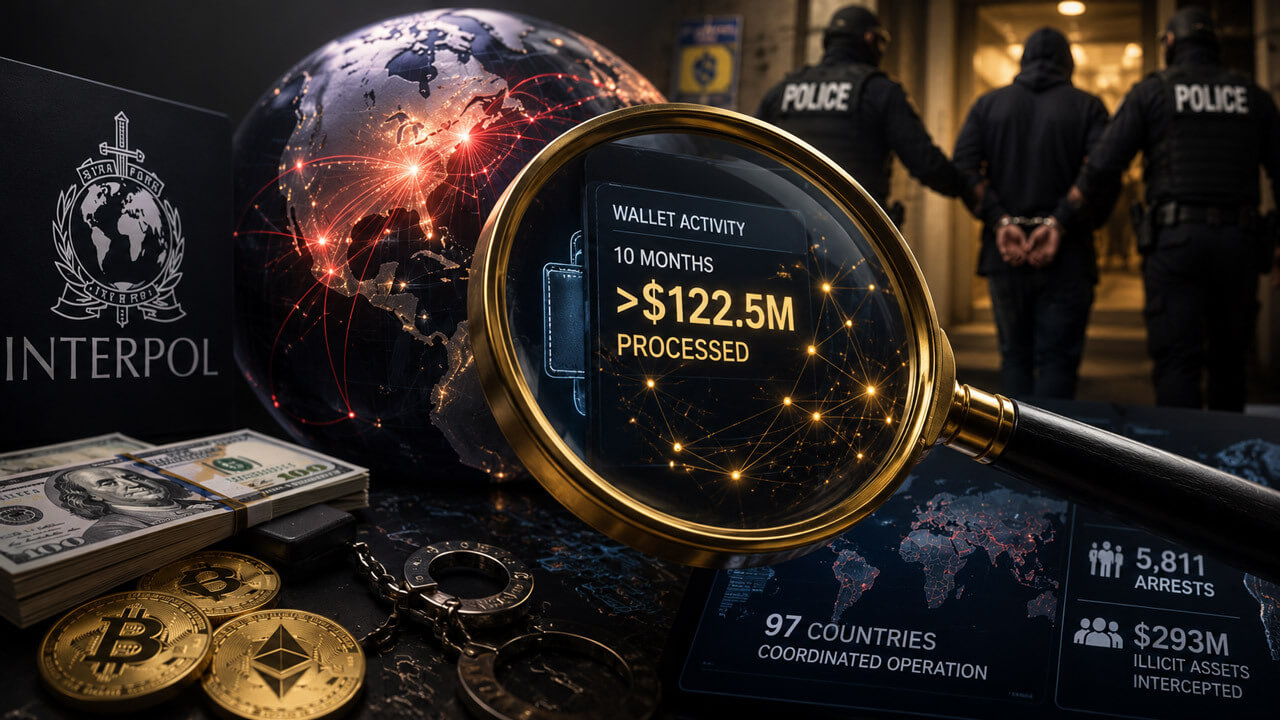
Interpol recently dismantled a massive international fraud ring after discovering a single cryptocurrency wallet tied to a 20-year-old suspect that processed over $122.5 million in illicit funds.
Interpol recently shut down a massive international fraud operation involving a 20-year-old suspect whose single crypto wallet processed over $122.5 million via complex cross-chain swaps.
Law enforcement agencies worldwide are sounding the alarm as digital asset fraud reaches unprecedented scales. This latest crackdown, spearheaded by Interpol, highlights how young tech-savvy criminals are leveraging complex blockchain maneuvers to hide stolen wealth. For American investors, the case serves as a stark reminder of the sophisticated risks present in the global crypto market.
The $122 Million Wallet and Operation First Light
During a coordinated global effort known as Operation First Light, Interpol targeted organized crime networks involved in phishing (fraudulent emails), investment scams, and money laundering. The most shocking discovery was a digital wallet controlled by a young individual in Thailand that moved nine-figure sums in record time.
The investigation reveals that these criminals often target victims through social engineering. By the time authorities closed in, the 20-year-old suspect had already facilitated the movement of millions of dollars across various digital borders. This operation spanned across dozens of countries, showing that crypto fraud prevention is now a top priority for international police forces.
How Cross-Chain Swaps Complicate Legal Tracing
The suspect utilized a technique known as cross-chain swaps (exchanging one type of cryptocurrency for another on a different blockchain). This method is often used to break the "paper trail" that investigators follow on public ledgers. By jumping from Bitcoin to Ethereum or privacy-focused coins, criminals hope to evade detection.
- Layering: Moving funds through multiple addresses to confuse trackers.
- Chain Hopping: Using decentralized bridges to switch between incompatible networks.
- Obfuscation: Utilizing mixing services to blend 'dirty' coins with clean ones.
Despite these tactics, forensic tools are becoming more advanced. According to data from CoinGecko, the market's vast liquidity across different chains makes these swaps easy for criminals to execute, but also creates a permanent record that investigators eventually decipher.
"The speed of digital transactions allows criminals to move millions in seconds, but the transparency of the blockchain ensures that the evidence never truly disappears."
The Global Scale of the Interpol Crackdown
The scope of this investigation was massive, leading to the seizure of roughly $257 million in assets and the arrest of over 5,800 individuals. Law enforcement agencies are no longer working in silos; they are now sharing real-time data to track wallets (software used to store crypto keys) across the globe.
- Interpol identifies suspicious transaction patterns.
- Local police conduct raids based on digital footprints.
- Exchanges freeze accounts linked to the suspect wallets.
- Legal teams begin the recovery process for victims.
The Rise of 'Pig Butchering' Scams
Many of the funds processed by the $122.5 million wallet originated from pig butchering (a long-term scam where fraudsters build trust with victims before stealing their money). These scams have become a multi-billion dollar problem in the United States, often targeting retirees and inexperienced retail investors.
What This Means for USA Investors
For US-based users on platforms like Coinbase, Kraken, or Gemini, this news reinforces the importance of using regulated exchanges. The IRS (Internal Revenue Service) keeps a close watch on large transfers, and the SEC (Securities and Exchange Commission) continues to push for stricter oversight of how tokens are swapped.
US investors should be aware that if their funds are stolen and moved through these international wallets, recovery is difficult but not impossible. The FBI's Internet Crime Complaint Center (IC3) works directly with Interpol to track these incidents. Additionally, Americans must report all crypto activity on their tax returns, even if the assets were involved in a scam, as the IRS may allow for certain loss deductions under specific conditions.
Protecting Your Digital Assets
Security is the best defense against these global syndicates. Always use Two-Factor Authentication (2FA) (a secondary security code) and never share your private keys (secret passwords) with anyone. If an investment opportunity sounds too good to be true, it likely is.
Key Takeaways
- Monitor wallet activity to detect sophisticated cross-chain laundering techniques used by modern scammers.
- Understand that Interpol's 'Operation First Light' resulted in 5,811 arrests across multiple jurisdictions.
- Recognize that moving assets between blockchains no longer provides total anonymity from law enforcement.
- Verify all investment platforms to avoid being caught in global phishing and 'pig butchering' schemes.