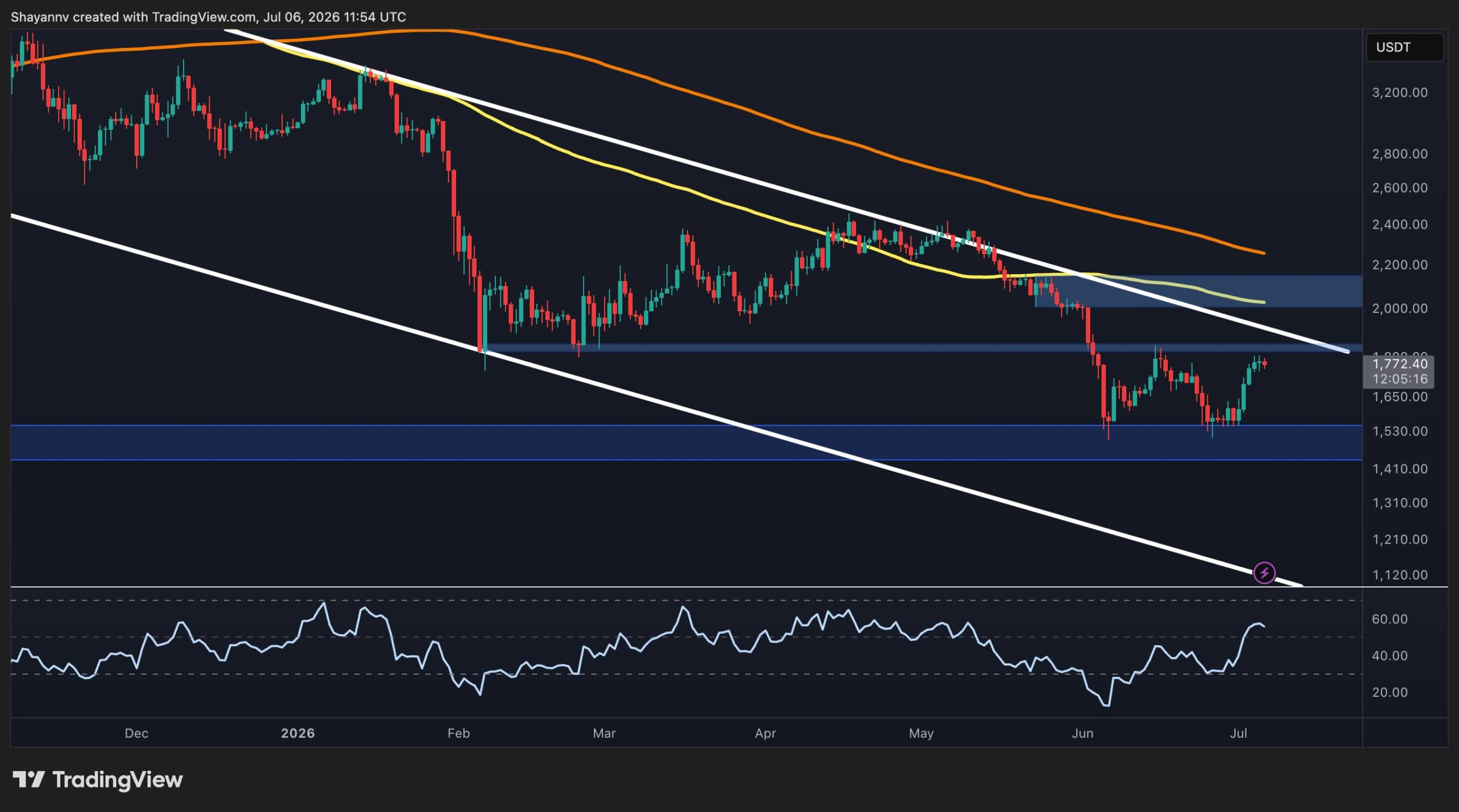
Ethereum is currently navigating a high-stakes recovery attempt as it battles to stay above the $1,500 psychological support level while eyeing a potential run toward the $2,000 mark.
Ethereum is currently caught in a tug-of-war between $1,500 and $2,000 as it tests a major technical resistance zone, with the outcome depending on its ability to sustain recent recovery momentum.
After a period of intense selling pressure, the world's second-largest cryptocurrency, Ethereum (ETH), is showing signs of life. US-based traders on platforms like Coinbase and Kraken are watching closely as the asset attempts to build a base near recent lows.
This pivot point matters significantly for American investors who have faced a volatile year. Whether this is a true trend reversal or just a "dead cat bounce" (a temporary recovery before more falling) remains the primary question for the market this week.
The Battle for $1,500 Support
Ethereum has successfully defended the $1,500 region multiple times, establishing what traders call a "strong floor." This price level is where buying interest historically outweighs selling pressure, preventing further crashes.
However, while the defense of this level is bullish, the broader trend is still under pressure from macroeconomic factors. High interest rates in the United States continue to make "risk-on" assets like crypto less attractive compared to traditional bonds.
If ETH can hold this support, analysts suggest it could form the foundation for a sustainable rally. If it fails, the next support zone sits considerably lower, which would likely trigger a wider market sell-off across all Altcoins (any cryptocurrency other than Bitcoin).
Testing the Confluence Resistance Area
Ethereum is currently heading straight into a "confluence resistance area." In technical analysis, this is a spot where multiple indicators, such as moving averages and trend lines, converge to create a tough barrier to price growth.
Breaking above this zone—roughly between $1,700 and $1,800—is essential for ETH to reach $2,000. Investors are looking for a high-volume breakout, which would signal that institutional buyers are stepping back into the market.
"The current price action suggests a market in transition, where the battle between bulls and bears is reaching a boiling point at key technical intersections."
If the price is rejected at this resistance, we may see another retest of the $1,500 lows. This would confirm that the current move was merely a relief rally within a larger downtrend (a period of consistently falling prices).
Short-Term Targets and Sentiment
For the bulls (investors expecting prices to rise), the immediate target is a daily close above $1,800. Achieving this would flip the market sentiment from cautious to optimistic, potentially sparking a FOMO (Fear Of Missing Out) rally toward $2,000.
On the flip side, the bears (investors expecting prices to fall) are focused on the exhaustion of the current move. They are waiting for signs that the recovery is losing steam to resume shorting the asset. This tension makes the relative strength index (a tool used to measure the speed and change of price movements) an important metric to watch.
Here are the primary factors influencing the current ETH price action:
- Bitcoin Correlation: ETH often follows Bitcoin's lead; if BTC breaks out, ETH likely follows.
- On-Chain Activity: Increased use of DeFi (financial services built on blockchain) can drive ETH demand.
- Exchange Inflows: Fewer coins on exchanges usually indicates investors are holding for the long term.
What This Means for USA Investors
For American investors, the Ethereum price trajectory isn't just about charts; it’s about the evolving regulatory and tax landscape. The IRS (Internal Revenue Service) treats cryptocurrency as property, meaning any gains from an ETH rally to $2,000 would be subject to capital gains taxes.
The SEC (Securities and Exchange Commission) continues to debate whether certain aspects of Ethereum constitute a security. This ongoing conversation affects how US exchanges like Gemini and Coinbase list and offer ETH-related products, such as staking rewards.
- Tax Planning: If you are up on your position, consider the difference between short-term and long-term capital gains rates.
- US Exchange Safety: Stick to regulated US platforms to ensure your assets are protected by domestic compliance standards.
- Dollar Strength: A strong US Dollar (DXY) typically puts downward pressure on the ETH/USD price pair.
Investors should also understand that the growing Investopedia DeFi explainer highlights how Ethereum's network utility often dictates its long-term value regardless of short-term price swings.
Conclusion: Is $2,000 Realistic?
While the path to $2,000 is fraught with technical obstacles, it remains a realistic target if the current support holds. The market is looking for a catalyst—perhaps a pause in Fed rate hikes or a major technological update—to provide the necessary fuel for a breakout.
Until a clear break of the $1,800 level occurs, cautious optimism is the name of the game. Beginners should avoid over-leveraging and focus on Dollar Cost Averaging (investing a fixed amount at regular intervals) to navigate the current volatility without emotional stress.
Key Takeaways
- Identify $1,500 as the critical support floor that prevents further bearish downside.
- Monitor the $1,700 to $1,800 range for signs of a breakout toward $2,000.
- Watch for Bitcoin correlation as a primary driver of short-term Ethereum volatility.
- Consider the impact of US regulatory sentiment on institutional ETH accumulation.
- Prepare for potential sideways trading if Ethereum fails to breach current resistance.