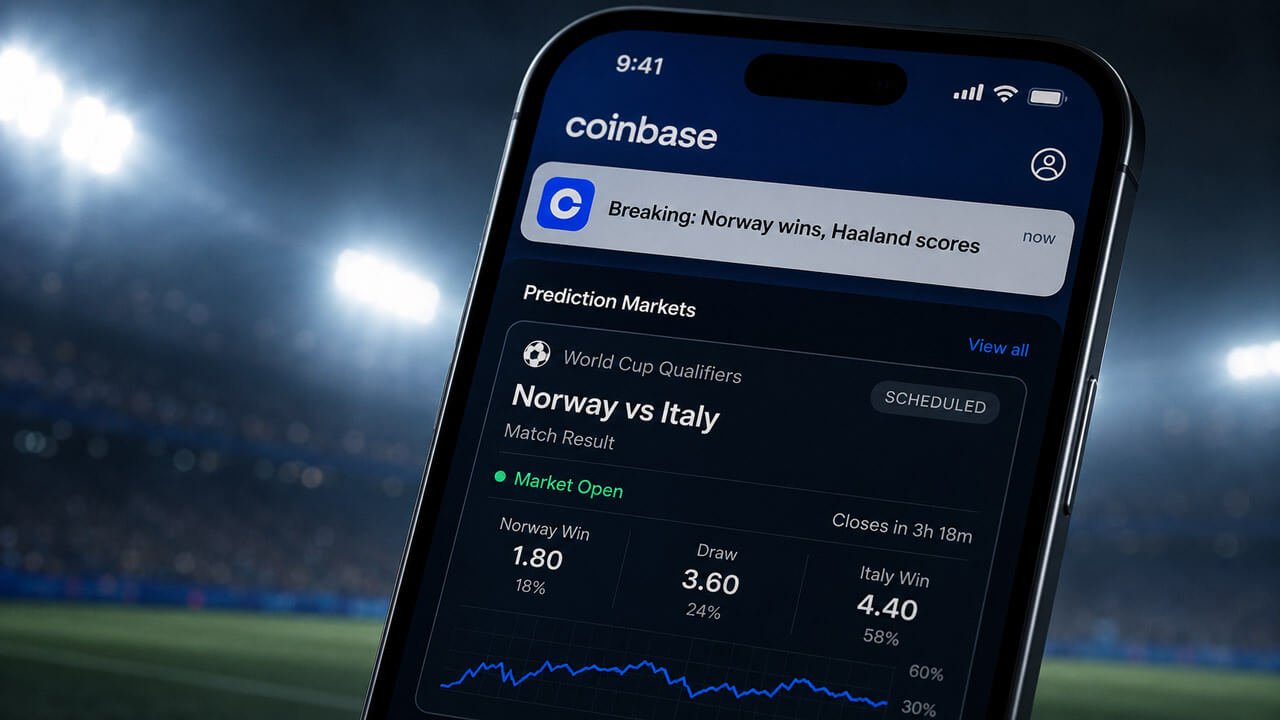
A technical error involving a World Cup alert on Coinbase has exposed the critical need for better data verification and transparent provenance within the growing crypto prediction market sector.
A recent reporting error by Coinbase during the World Cup highlights significant flaws in how centralized exchanges verify external data for prediction markets.
During a major international soccer match, Coinbase users received notification alerts containing incorrect game data. While this may seem like a minor glitch, it highlights a massive structural issue for crypto prediction markets (platforms where users bet on the outcome of real-world events).
For American investors, who are increasingly using exchanges like Coinbase to track both prices and event-based assets, this incident serves as a wake-up call. If an automated system provides false data, it can trigger liquidations or bad trades before a human can intervene. Here is why the industry is currently struggling with a "proof problem."
The Rising Popularity of Prediction Markets
Prediction markets act as a decentralized crystal ball, allowing traders to buy shares in the outcome of elections, sports, or economic data. In the United States, these markets have gained massive traction as an alternative to traditional polling or betting. However, for these markets to work, they require Oracles (services that feed real-world data into a blockchain).
When an exchange like Coinbase integrates these alerts directly into their mobile app, they become a de facto source of truth for millions of retail investors. The recent error suggests that the provenance (the documented history and source of data) is currently too opaque for high-stakes financial decisions.
According to data from CoinGecko, the market capitalization of prediction-related tokens has fluctuated wildly based on the perceived accuracy and legality of these platforms in the USA.
Why Automated Content Scales Poorly Without Oversight
The push toward automation is a double-edged sword for crypto companies. On one hand, it allows for instant updates; on the other, it removes the human editorial layer that prevents misinformation. When automated systems pull from a single, unverified API (an interface that allows two apps to talk to each other), the risk of a single point of failure increases.
- Data Integrity: Automated alerts must be cross-referenced across multiple independent data providers.
- Latency Issues: Speed should never come at the cost of accuracy in a trading environment.
- User Protection: Incorrect alerts can lead to "panic selling" or "FOMO buying" based on false pretenses.
The Importance of Decentralized Oracles
To solve the proof problem, many developers are turning to decentralized oracles. Unlike a central server that could be wrong or hacked, decentralized systems reach a consensus (a general agreement) by polling multiple sources before reporting an outcome to the blockchain.
- Aggregating data from at least five independent sports or news feeds.
- Using economic incentives to punish providers who report false data.
- Providing a transparent trail on the blockchain (a public digital ledger) so any user can verify the source.
"The reliability of data is the bedrock of decentralized finance. Without verifiable truth, prediction markets are simply high-risk gambles controlled by opaque algorithms."
What This Means for USA Investors
For investors in the United States, the Coinbase error adds another layer of complexity to an already tight regulatory environment. The Commodity Futures Trading Commission (CFTC) has historically been skeptical of prediction markets, often viewing them as unregulated gambling which is restricted in many states.
From a tax perspective, the IRS (Internal Revenue Service) treats gains from these markets as taxable income. If a user loses money due to an exchange’s reporting error, claiming those losses can be a bureaucratic nightmare. Most major US exchanges, including Coinbase, Kraken, and Gemini, are under immense pressure to ensure their data feeds are 100% accurate to avoid consumer protection lawsuits.
Key Considerations for US Traders:
Most prediction market activity for US residents happens on platforms like Polymarket, though often through complex legal workarounds. If you are trading based on alerts from a US-regulated exchange, remember that these notifications are often "for informational purposes only." This fine print usually protects the exchange from liability if their automated system makes a mistake.
The Path Toward Verified Event Data
As we move toward the next generation of Web3 (the decentralized internet), the industry must prioritize "Proof of Truth." This involves moving away from centralized alerts and toward open-source protocols where the data source is always visible. For the average investor, this means double-checking major news on secondary sites before executing a trade based on a mobile push notification.
In summary, the Coinbase glitch is a minor event with major implications. It proves that while the infrastructure for crypto trading is ready for the masses, the infrastructure for verifiable real-world data still has a long way to go.
Key Takeaways
- Identify the 'proof gap' in how crypto exchanges process and display real-world event data for users.
- Recognize the importance of transparent provenance in decentralized prediction market platforms.
- Evaluate the risks of relying on automated trading alerts without secondary verification steps.
- Understand why the SEC and CFTC are closely monitoring the evolution of crypto-based event wagering.