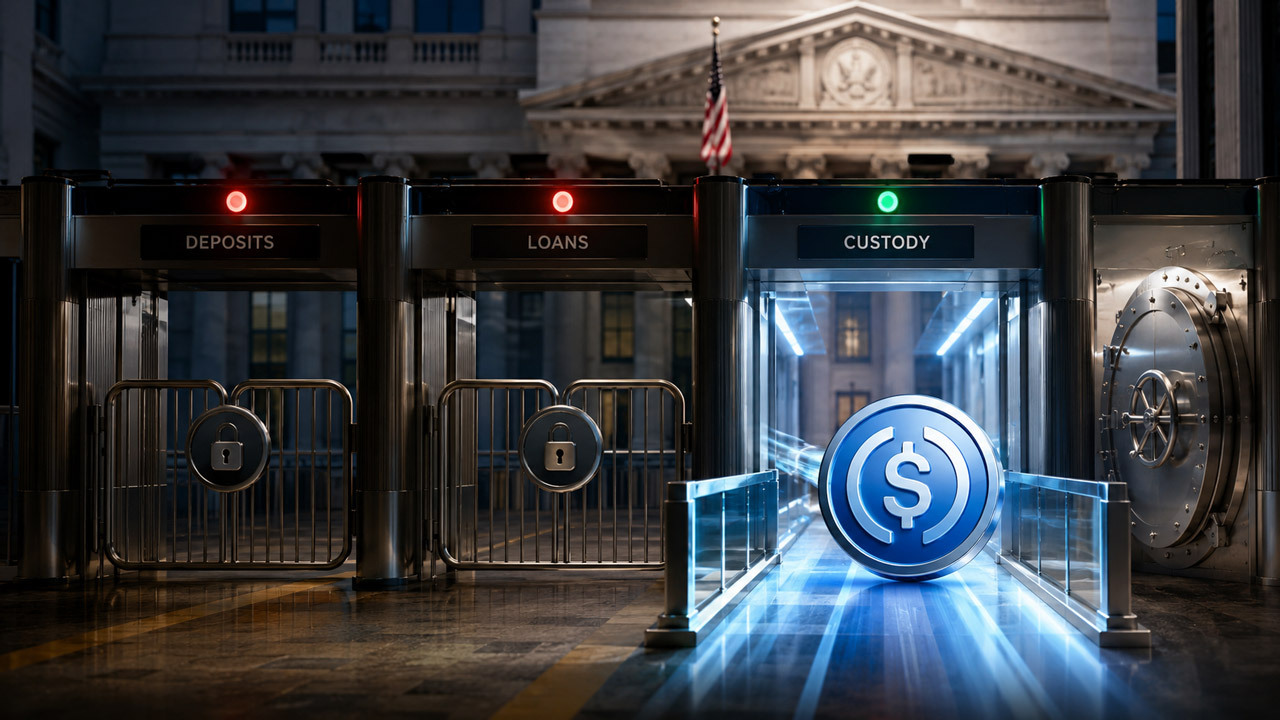
Circle Internet Financial has secured a U.S. National Trust Bank charter, a move that allows the stablecoin issuer to provide internal custody services while maintaining strict limits on traditional banking activities.
Circle has received a U.S. National Trust Bank charter, allowing it to handle internal custody services but prohibiting it from offering traditional savings accounts or loans.
The Boston-based fintech giant behind USDC—the world’s second-largest stablecoin (a digital currency pegged to the U.S. Dollar)—has officially launched the Circle National Trust. This development marks a significant milestone in the company's long-standing effort to integrate more deeply with the American financial system. For U.S. investors, this represents a shift toward higher regulatory oversight and transparency for the assets backing their digital dollars.
Defining the Circle National Trust Charter
Unlike a traditional commercial bank you might see on a street corner, a national trust bank is a specialized institution. It is chartered by the Office of the Comptroller of the Currency (OCC), a primary federal regulator in Washington, D.C. This specific license allows Circle to hold assets in trust for its clients, acting as a highly regulated vault rather than a lender.
In its initial phase, the Circle National Trust will focus exclusively on providing custody (the secure storage and management of digital assets) for Circle itself and its various corporate affiliates. This internal structure is designed to streamline how the company manages its own vast resources and technological infrastructure. This move reinforces Circle's position in the market as it competes for dominance against other major players listed on CoinGecko.
"A national trust charter provides a standardized federal framework that avoids the 'patchwork quilt' of varying state-by-state money transmitter licenses usually required for crypto firms."
What the Trust Bank Cannot Do
It is equally important for American investors to understand the limitations of this new charter. Because it is a trust charter and not a full commercial banking license, Circle is prohibited from engaging in several common banking activities. These restrictions are in place to manage risk and ensure the institution remains focused on asset safety rather than speculative growth.
- No Retail Deposits: You cannot open a standard checking or savings account with Circle National Trust.
- No Lending: The bank cannot use its holdings to issue mortgages, car loans, or personal lines of credit.
- No FDIC Insurance for Crypto: While the institution is federally regulated, digital assets held in custody typically do not carry the same government-backed insurance as cash in a savings account.
Future Goals: USDC Reserves and Institutions
While the current scope is limited to internal operations, Circle has transparently communicated its long-term ambitions for the charter. The company eventually hopes to expand the trust's capabilities to include institutional custody for external clients like hedge funds and family offices. This would allow large-scale US investors to store their crypto under a federally overseen entity.
Furthermore, Circle aims to eventually move the management of USDC reserves—the cash and Treasuries that back the stablecoin—under this trust umbrella. Currently, these reserves are managed by giants like BlackRock and stored at various partner banks. Bringing this in-house would theoretically increase Circle's profit margins and operational control over the stablecoin's stability.
- Phase 1: Internal custody for Circle and its subsidiaries.
- Phase 2: Seeking regulatory approval for external institutional custody.
- Phase 3: Direct management of the multi-billion dollar USDC reserve fund.
What This Means for USA Investors
For the average American crypto user, Circle's federal charter is a net positive for regulatory clarity. The SEC (Securities and Exchange Commission) and CFTC (Commodity Futures Trading Commission) have been closely watching stablecoin issuers. By moving under the OCC's wing, Circle is signaling that it welcomes federal supervision, which may reduce the risk of sudden regulatory crackdowns that often cause price volatility.
Regarding IRS tax treatment, the existence of this trust does not change your filing requirements; using USDC still triggers capital gains obligations whenever it is traded for another asset. However, if Circle eventually offers institutional services, it may lead to more robust 1099-B reporting for high-net-worth users. USDC remains widely available on major US-regulated exchanges like Coinbase and Kraken, and this banking move likely secures that accessibility for the foreseeable future.
The Difference Between Trust and Risk
Investors should recognize that while "Trust" is in the name, all crypto investments carry inherent market risk. A trust charter ensures that the math is checked by the government, but it does not guarantee that the value of digital assets will never fluctuate. For those holding USDC as a "safe haven" during market downturns, the news offers a layer of comfort regarding the issuer's long-term viability in the domestic US market.
Key Takeaways
- Identify the new charter as a limited-purpose national trust bank approved by US regulators.
- Recognize that Circle cannot take deposits or issue loans like traditional retail banks.
- Understand that the trust will initially focus on internal custody and affiliate services.
- Monitor future expansion into institutional custody and USDC reserve management.
- Evaluate this as a major step toward institutional legitimacy for the USDC issuer.