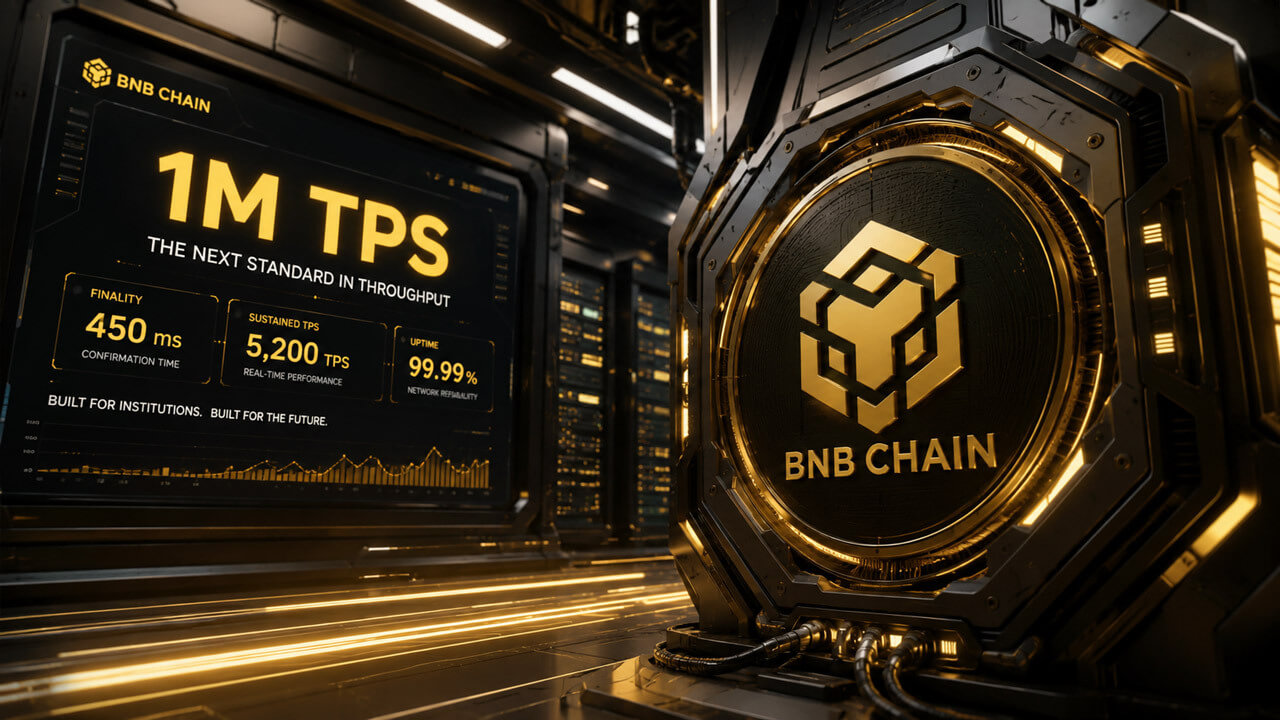
BNB Chain is launching a massive technical overhaul to reach one million transactions per second (TPS) while integrating privacy features to support the growing economy of autonomous AI agents.
BNB Chain is overhauling its architecture to support 1 million transactions per second and protocol-level privacy to attract AI agents and institutional finance.
The Binance-backed network is pivoting its strategy as the broader market enters a period of high volatility. This shift aims to position the blockchain as the primary infrastructure for both Wall Street institutions and software-driven artificial intelligence programs.
For US investors, this move is significant because it marks a transition from a retail-focused exchange chain to a high-performance industrial layer. While the news comes as the BNB token hits yearly lows, the long-term roadmap focuses on utility and scalability.
The Moonshot Goal: One Million TPS
BNB Chain is aiming for a milestone that currently exceeds the performance of almost every existing network: one million Transactions Per Second (TPS). TPS is a metric that measures how many individual actions a network can process in a single second.
To achieve this, the network is moving toward a more modular architecture. This means breaking the blockchain into separate layers for specialized tasks like data storage and transaction execution. This approach reduces congestion and allows for massive scaling.
According to data from CoinGecko, BNB Chain remains one of the most active ecosystems by daily volume, but this upgrade is necessary to handle the demands of automated agents.
"The future of the decentralized web won't just be powered by humans; it will be driven by millions of AI agents performing micro-transactions every second."
Integrating Privacy for Big Finance
Beyond speed, the second pillar of this upgrade is protocol-level privacy. Many US-based financial institutions have stayed away from public blockchains because their transaction history is visible to everyone.
The network is implementing Zero-Knowledge (ZK) proofs. This is a cryptographic method that allows one party to prove a statement is true without revealing the underlying data. This is essential for compliance and trade secrets.
The new roadmap includes several core technical goals:
- Enhancing Zero-Knowledge Proofs to hide sensitive transaction details while remaining auditable.
- Reducing Latency to ensure that financial trades execute in milliseconds.
- Interoperability, allowing assets to move seamlessly between different sub-networks.
Capturing the AI Agent Economy
The most unique aspect of this pivot is the focus on AI agents. These are autonomous software programs that can navigate the web, manage wallets, and pay for services without human intervention.
These agents require a “high-throughput” (high-capacity) network that is extremely cheap to use. If an AI needs to make 500 small payments a minute, gas fees (transaction costs) must be near zero.
The BNB Chain strategy involves three phases for AI integration:
- Deploying data layers specifically for training Large Language Models (LLMs).
- Creating decentralized identity tools so AI agents can be verified.
- Launching dedicated "Sidechains" (separate blockchains connected to the main chain) for high-frequency AI activity.
BNB Price Struggles Amid the Pivot
Despite these ambitious technical goals, the price of BNB has faced significant downward pressure. The token recently slipped to its lowest point in 2024, reflecting investor uncertainty about the broader economy.
Market analysts note that technical upgrades often take months or years to reflect in token price. While the "One Million TPS" goal is a long-term target, the immediate market is focused on US interest rates and regulatory clarity.
However, supporters argue that by building for the "AI economy," the network is diversifying its utility beyond simple retail trading. This could provide a fundamental floor for the asset in the coming years.
What This Means for USA Investors
For investors in the United States, the BNB Chain evolution carries specific implications. While Binance.com does not operate in the US, the BNB token is available on several regulated platforms and the decentralized network itself is globally accessible.
Regulatory and Tax Context
The SEC (Securities and Exchange Commission) has previously scrutinized the nature of the BNB token. US investors should be aware that the regulatory status of exchange-linked tokens remains a point of active debate in Washington D.C.
From a tax perspective, the IRS (Internal Revenue Service) treats BNB as property. Any gain from selling BNB, or even using it to pay for transaction fees on the chain, may trigger a capital gains tax event. Keeping accurate records via US-compatible tax software is highly recommended.
Exchange Availability
While the main Binance exchange is restricted, US residents can typically access BNB and its ecosystem through:
- Binance.US (where available by state).
- Trust Wallet or MetaMask for decentralized swaps.
- KuCoin or other international platforms with limited US service.
The move toward institutional privacy features may eventually make the chain more attractive to US-based fintech firms, potentially leading to increased demand for the token within American markets.
Key Takeaways
- Execute a massive architectural shift to support 1 million transactions per second (TPS).
- Introduce zero-knowledge privacy features to attract traditional financial institutions.
- Target the emerging economy of autonomous AI agents requiring high-speed data processing.
- Address recent price volatility as BNB tests its lowest support levels of 2024.