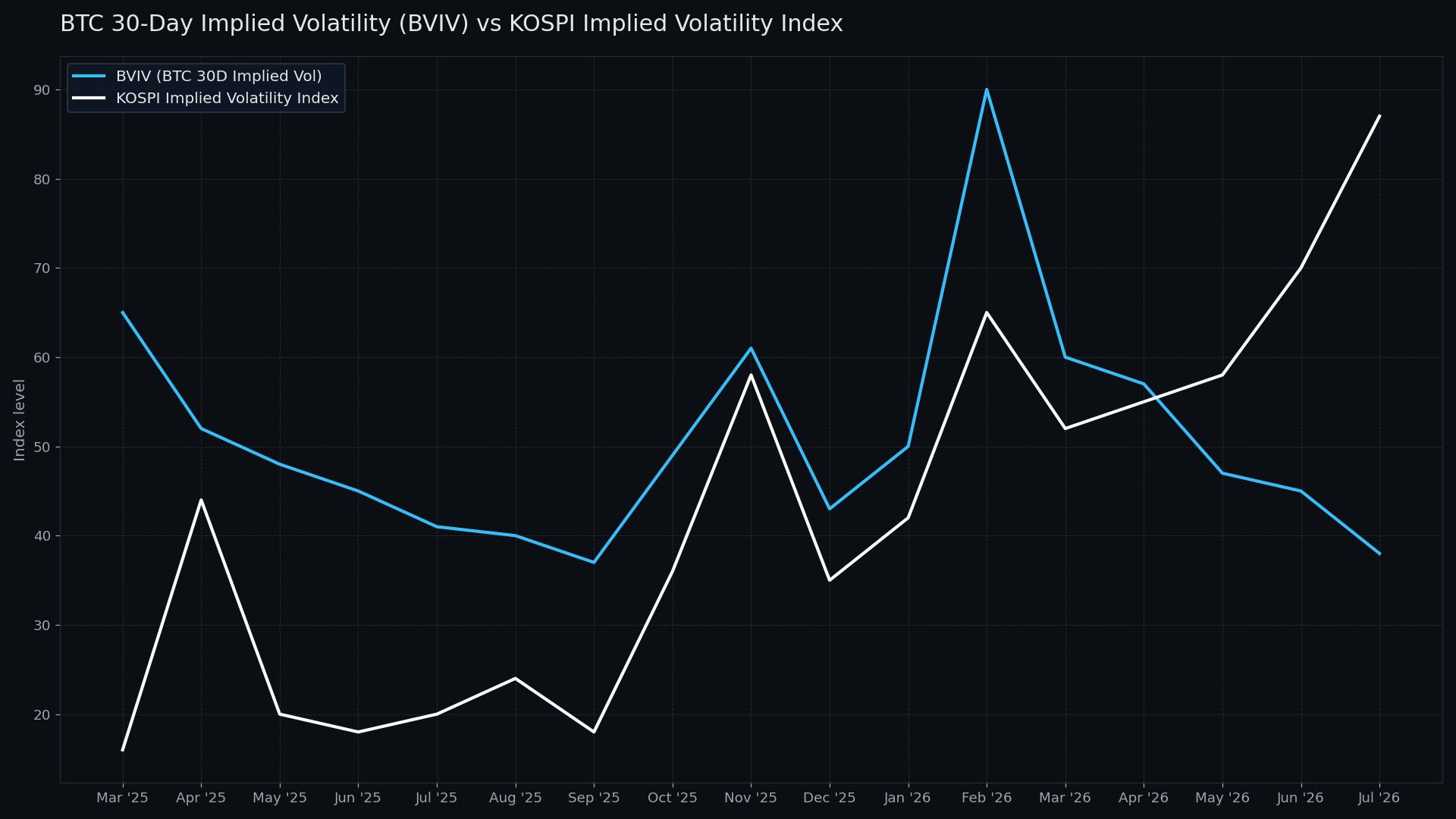
Bitcoin's current price movements have become more stable than many traditional tech investments, signaling a major shift in how the largest cryptocurrency behaves during global market transitions.
Bitcoin has become significantly less volatile than international tech stocks as the initial artificial intelligence investment frenzy slows down, transitioning the asset toward a more stable store of value.
As of mid-July 2026, Bitcoin (BTC) is exhibiting a rare period of calm, with price fluctuations lower than several high-profile tech stocks, particularly those in the South Korean electronics and AI sectors. For American investors, this trend marks a turning point where Bitcoin is no longer the most volatile asset in a standard diversified portfolio. This shift comes as the massive capital rotation into Artificial Intelligence (AI) companies begins to level off, causing a spikes in volatility for tech equities that were previously considered 'safe' compared to crypto.
The Great Stabilization of Bitcoin
For years, Bitcoin was criticized by Wall Street for its wild price swings. However, recent data suggests that the 'digital gold' narrative is finally taking hold among institutional buyers. Volatility (the rate at which the price of an asset increases or decreases for a set of returns) has reached multi-year lows for BTC.
While tech-heavy indexes are vibrating with uncertainty due to slowing AI growth projections, Bitcoin is holding a steady range. This stability is largely attributed to the maturity of the market and the presence of US Spot Bitcoin ETFs (Exchange-Traded Funds) which provide a structural floor for the price. According to data tracked by CoinGecko, Bitcoin's market capitalization remains dominant even as trading volumes transition from retail speculation to institutional holding.
AI Hype Meets a Reality Check
The tech world spent the last few years in a frenzy over AI hardware and software integration. But as quarterly earnings reports show diminishing returns on massive AI infrastructure investments, investors are pulling back. This 'cooling off' period has led to significant sell-offs in major tech corridors, notably in South Korea where semiconductor giants reside.
- Market Saturation: Investors are questioning the short-term profitability of expensive AI chips.
- Capital Flight: Liquid cash is moving out of overheated tech stocks and into more stable 'value' plays.
- Risk Parity: Some hedge funds are now viewing Bitcoin as a lower-risk alternative to over-leveraged AI startups.
"When the most speculative corners of the stock market start moving faster than Bitcoin, it tells you that the crypto market has reached a new level of maturity and institutional acceptance."
Bitcoin vs. Global Tech Stocks
To understand the current environment, we must look at the Sharpe Ratio (a measure for calculating risk-adjusted return). Bitcoin's risk-adjusted performance is currently outshining traditional tech stocks that are grappling with supply chain issues and changing trade policies. The contrast is sharpest when looking at South Korean indices, which are often a bellwether for global tech demand.
- Bitcoin price range-bound between $60,000 and $70,000 for consecutive months.
- Tech stocks experiencing 5% to 8% daily swings on minor news cycles.
- Decreased correlation between BTC and the Nasdaq 100 index.
What This Means for USA Investors
For investors in the United States, this period of low volatility offers a unique window for portfolio rebalancing. Since Bitcoin is acting more like a stable commodity, its role in a 401(k) or brokerage account via platforms like Coinbase or Kraken is changing from a 'glory or zero' bet to a strategic hedge.
From a tax perspective, the IRS (Internal Revenue Service) treats Bitcoin as property. Lower volatility means fewer 'taxable events' for active traders, as there are fewer sudden spikes to trigger panic sells or profit-taking. Furthermore, the SEC (Securities and Exchange Commission) continues to monitor the market, but the current stability may lead to smoother approvals for more complex crypto-financial products in the future.
Key Considerations for US Portfolios:
If you hold Bitcoin on a US-regulated exchange, you should be aware that while the price is stable in USD terms, the underlying technology continues to evolve. US investors should keep an eye on federal interest rate decisions, as these often have a larger impact on 'stable' assets than they do on highly speculative ones.
The Future of Crypto Stability
Is Bitcoin's new low-volatility phase permanent? Most analysts suggest that while bull markets will always bring some level of excitement, the days of 20% daily crashes may be behind us. As Bitcoin becomes more integrated into the global financial system, its movements will likely mirror slow-moving assets like gold or silver rather than penny stocks.
This 'boring' phase of Bitcoin's price action is actually a sign of health. It allows for the development of DeFi (Decentralized Finance, or financial services built on blockchain) applications that require stable collateral. For the intermediate investor, this is the time to focus on long-term accumulation rather than chasing the next AI-driven stock pump.
Key Takeaways
- Monitor Bitcoin's shift from a speculative asset to a mature 'digital gold' with lower daily price swings.
- Compare crypto stability against traditional tech-heavy markets that are currently seeing higher turbulence.
- Evaluate your portfolio's risk-reward ratio as the AI-driven equity boom begins to plateau.
- Watch for institutional accumulation as lower volatility often attracts conservative US-based fund managers.