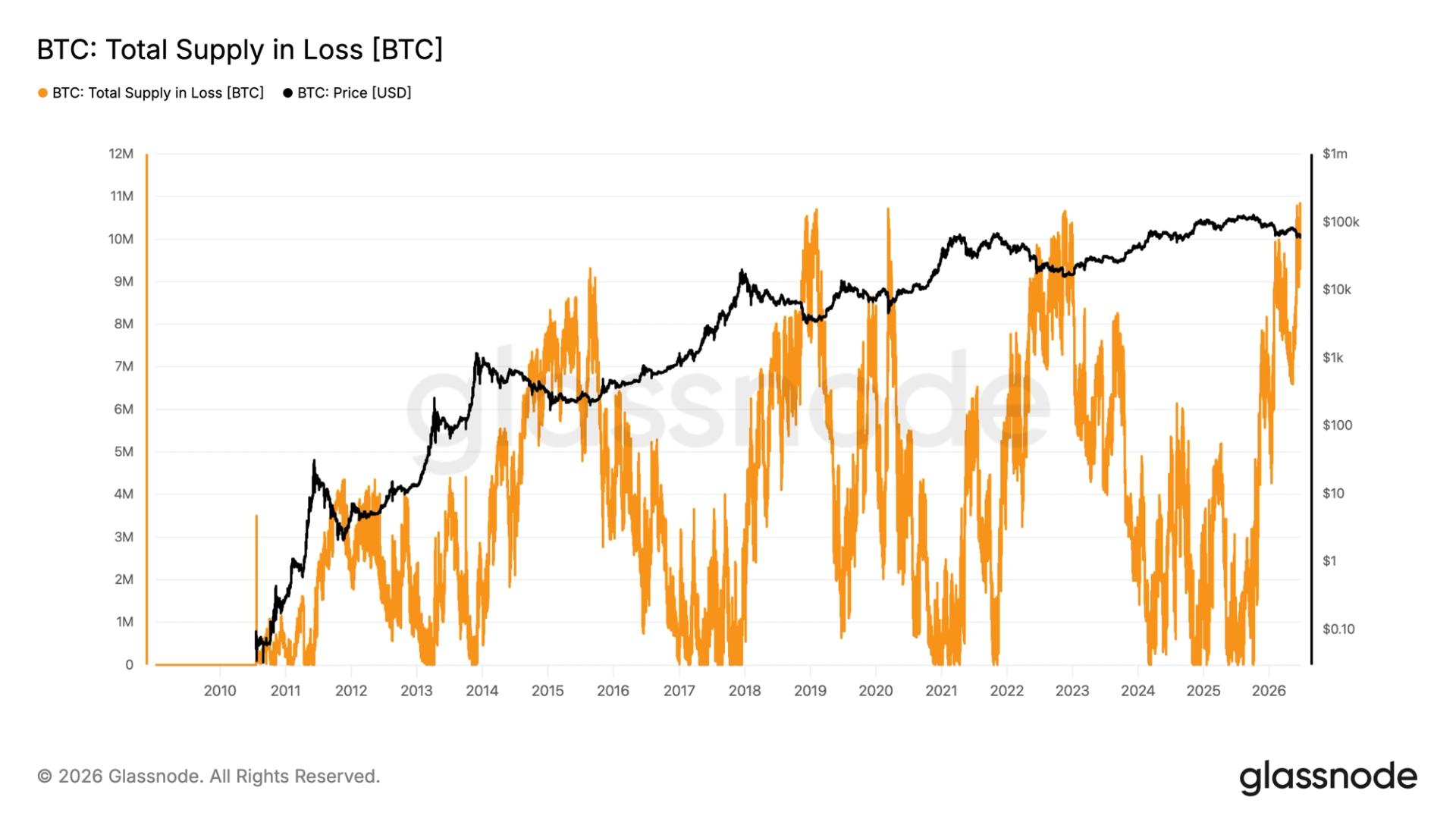
As the crypto market navigates a period of cooling prices, a record 10.83 million Bitcoin (BTC) are currently held 'in loss,' meaning their current market value is lower than the price they were originally purchased for.
A record 10.83 million Bitcoin are currently being held at a loss, while long-term investors have reached a peak holding of 14.8 million BTC, signaling a major market shift.
This massive shift in market data indicates that nearly 55% of the total circulating Bitcoin supply is currently 'underwater' for American and global investors. While the numbers might seem alarming at first glance, institutional analysts usually view this level of 'pain' as a precursor to a market bottom.
Understanding Bitcoin Supply in Loss
In on-chain analysis (the study of data directly on the blockchain), supply in loss refers to the number of individual coins that were last moved when the price was higher than it is today. When this number reaches record highs, it suggests that the majority of recent buyers are holding onto their assets despite seeing red in their portfolios.
For US investors monitoring their CoinGecko dashboards, this suggests a phase of 'capitulation' (a market stage where discouraged sellers exit, leaving only strong holders). Historically, when the amount of Bitcoin in loss reaches these extremes, selling pressure often exhausts itself because those remaining refuse to sell at such deep discounts.
Long-Term Holders Reach Record Dominance
While millions are facing paper losses, the 'smart money' appears to be doubling down. Data shows that long-term holders (investors who have held their BTC for more than 155 days) now control a staggering 14.8 million BTC. This is the highest level of conviction ever recorded in the history of the asset class.
This group is often referred to as 'diamond hands' (investors who refuse to sell during high volatility). Their behavior is critical for the following reasons:
- Reduced Sell Pressure: These coins are typically stored in cold wallets (offline storage) rather than on exchanges.
- Market Scarcity: As more BTC is 'locked away' by long-term holders, the available supply for new buyers shrinks.
- Institutional Floor: Growing holdings suggest that large players are treating current prices as a long-term value play.
"When the supply in loss reaches these historic peaks while long-term holding increases, we aren't just looking at a dip; we are looking at the transfer of wealth from impatient traders to patient accumulators."
The Mechanics of a Supply Squeeze
A supply squeeze (a situation where demand outstrips a very low available supply) becomes much more likely when such a large portion of Bitcoin is held by people who aren't selling. If a new wave of demand hits the market—perhaps from a new spot ETF (Exchange Traded Fund) or a change in US Federal Reserve policy—there may not be enough BTC on exchanges to satisfy it.
Current Market Sentiment
The sentiment among retail investors in the USA remains cautious. However, the divergence between the 'supply in loss' and 'long-term holder supply' suggests that the core network participants are not panicked. They are waiting for the next macro catalyst to drive prices back toward the 'in-profit' zone.
- Step 1: Monitor the 'Percent Supply in Profit' metric.
- Step 2: Watch for a decrease in the amount of BTC held on US exchanges like Coinbase and Kraken.
- Step 3: Track the movement of 'whales' (entities holding 1,000 or more BTC).
What This Means for USA Investors
For investors based in the United States, these on-chain metrics carry specific implications. From a tax perspective, holding Bitcoin 'in loss' allows for 'tax-loss harvesting' (selling an asset at a loss to offset capital gains taxes on other investments). The IRS (Internal Revenue Service) currently treats cryptocurrency as property, meaning these underwater positions could actually provide a strategic tax advantage for some portfolios.
Furthermore, major US exchanges like Coinbase and Gemini have seen consistent outflows. This supports the narrative that Americans are moving their assets into self-custody rather than keeping them ready to sell. The SEC (Securities and Exchange Commission) continues to scrutinize the market, but the growing 'diamond hand' cohort suggests that regulatory uncertainty hasn't broken the long-term investment thesis for many US households.
Looking Ahead: The Path to Recovery
Market cycles for Bitcoin generally follow a pattern of accumulation, expansion, and distribution. We are currently firmly in an accumulation phase. While the 'supply in loss' figure of 10.83 million BTC sounds negative, it actually cleanses the market of 'weak hands' (speculative traders who sell at the first sign of trouble).
For the intermediate investor, the focus should remain on the long-term trend. As long as the long-term holder supply remains at record highs, the structural integrity of Bitcoin's price floor appears robust, regardless of short-term USD fluctuations.
Key Takeaways
- Identify that 10.83 million BTC are currently held at prices higher than the current market value.
- Recognize that long-term holders now control a record-breaking 14.8 million Bitcoin.
- Evaluate the potential for a 'supply squeeze' as coins move from active trading to long-term storage.
- Understand why high 'supply in loss' often precedes a market bottom and subsequent price recovery.
- Monitor US exchange liquidity as more Bitcoin is removed from active circulation by 'diamond hands'.