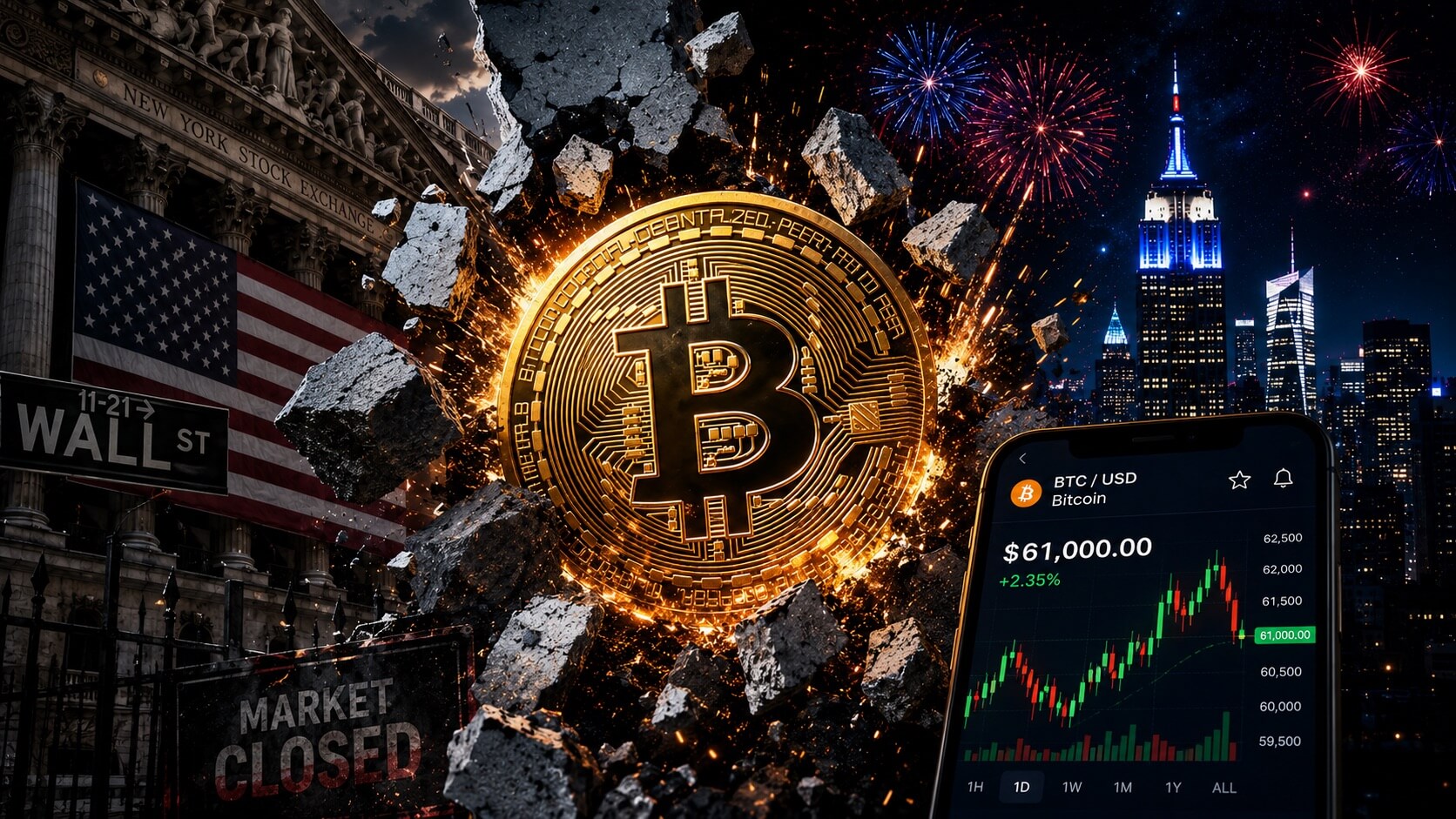
Bitcoin continues to trade around the clock on Independence Day, but investors should brace for thinner liquidity as traditional U.S. financial markets and ETF rails shut down for the holiday.
Bitcoin maintains 24/7 trading availability during the July 4th holiday, but the closure of U.S. banks and stock exchanges leads to lower liquidity and higher potential for price volatility.
While the rest of the American financial system takes a breather this July 4th, the cryptocurrency market remains wide open. For U.S. investors, this provides a unique look at Bitcoin’s role as "freedom money" that operates independent of government calendars. However, this independence comes with a trade-off: lower liquidity (the ease of buying or selling an asset without changing its price).
The Intersection of Bitcoin and Independence Day
For years, crypto enthusiasts have hailed Bitcoin as a tool for financial sovereignty. This Independence Day, that narrative is put to the test as Wall Street closes its doors. U.S. banks, the Federal Reserve’s wire systems, and the NASDAQ all pause operations, meaning no new capital can flow from traditional bank accounts into crypto exchanges today.
This shutdown creates a "liquidity gap." When large institutions and market makers (firms that provide steady buy and sell orders) are away, even small trades can move the price of Bitcoin more significantly than usual. This is why many traders refer to holiday periods as high-risk windows for volatility (rapid and unpredictable price changes).
Why ETF Closures Matter for BTC Prices
The landscape of Bitcoin trading changed permanently in early 2024 with the launch of Spot Bitcoin ETFs (Exchange-Traded Funds). Because these funds trade on the stock market, they are currently inactive. Investors cannot buy into the BlackRock or Fidelity Bitcoin funds until the next business day.
"Liquidity is the lifeblood of stable markets; when the U.S. institutional engine turns off, the remaining retail volume is often not enough to prevent sharp, jagged price swings."
According to data from CoinGecko, global trading volume often dips during major Western holidays. Without the billions of dollars in daily ETF flow, the market relies heavily on global retail traders in Asia and Europe to maintain price floors.
Understanding Slippage and Spread Today
If you are planning to trade today, you need to understand two key concepts: spread and slippage. The spread is the difference between the highest price a buyer will pay and the lowest price a seller will accept. In low-liquidity environments, this gap widens.
- Wide Spreads: You might pay a higher premium when buying or get less when selling.
- Increased Slippage: Your order might be executed at a different price than you expected.
- Reduced Depth: Large orders could "eat through" the order book quickly, causing a flash crash or spike.
What This Means for USA Investors
For the average American investor, the holiday creates a tactical challenge. Since most Americans use U.S.-based exchanges like Coinbase, Kraken, or Gemini, they are directly affected by the lack of domestic banking rails. If you didn't move USD (U.S. Dollars) onto an exchange before the banks closed, you may be unable to buy a sudden dip.
- Tax Implications: The IRS treats every crypto-to-crypto trade as a taxable event, even on holidays.
- Bank Delays: ACH transfers initiated today won't process until the next banking business day.
- Regulatory Calm: The SEC and CFTC are also closed, meaning a temporary break from regulatory headlines.
While Bitcoin’s price is often quoted in U.S. Dollars, it is a global asset. If a major news event occurs while Americans are at barbeques, the price will react on international exchanges first, potentially leaving U.S. investors to wake up to a different market reality on July 5th.
Strategies for Trading Low-Liquidity Days
Experienced investors often use limit orders (an order to buy or sell at a specific price) rather than market orders (an order to buy or sell immediately at the best available price). This protects you from getting a bad price during a temporary liquidity vacuum. If you are a long-term holder, the best strategy for the holiday is often to simply enjoy the fireworks and ignore the short-term noise.
Key Takeaways
- Expect higher price volatility as U.S. institutional trading desks and banks close for the holiday.
- Monitor wider bid-ask spreads on major U.S. exchanges like Coinbase and Kraken during low-volume hours.
- Recognize that Spot Bitcoin ETFs will not trade until the New York Stock Exchange reopens.
- Prepare for potential 'flash' moves driven by retail traders without the stabilizing force of institutions.