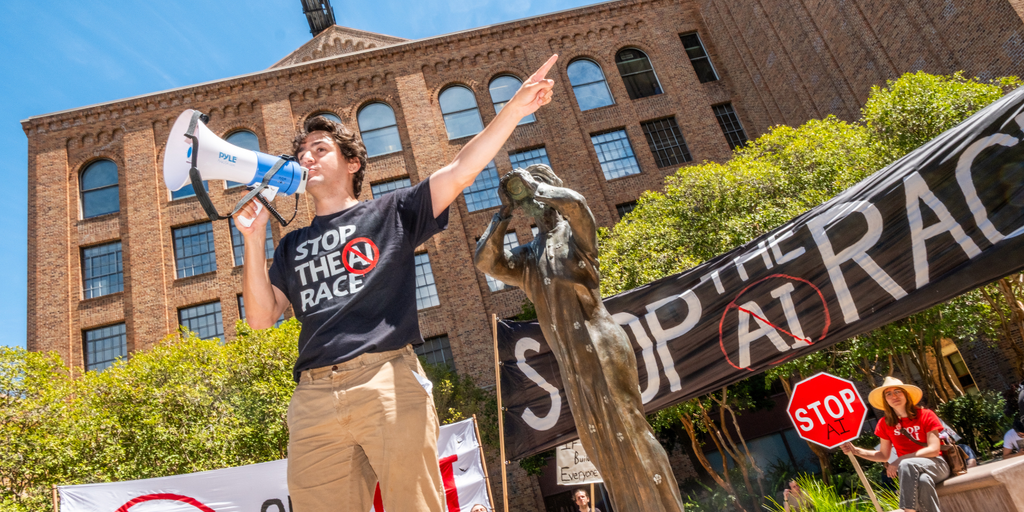
Public demonstrators in San Francisco are calling for a formal pause in the development of hyper-powerful artificial intelligence models to prevent potential societal risks.
Approximately 200 protesters marched through San Francisco, demanding that major tech firms like OpenAI and Google DeepMind pause the development of advanced artificial intelligence due to safety and job security risks.
On a recent Saturday in California, roughly 200 activists took to the streets of San Francisco, the global epicenter of the AI boom. They marched directly to the doors of the industry's most influential companies, including OpenAI and Google DeepMind. For US investors, this represents a growing friction point that could lead to new federal regulations or slowdowns in tech valuations.
The March Against Rapid AI Expansion
The protest targeted the physical headquarters of firms leading the race toward Artificial General Intelligence (systems that can perform any intellectual task a human can). The demonstrators carried signs warning of existential risks and the potential for massive job losses across the United States. They argue that the current pace of development is outstripping our ability to control these systems.
Participants highlighted specific concerns that resonate with the American workforce. From Hollywood writers to Silicon Valley engineers, the fear is that unchecked automation could lead to permanent economic displacement. The march signifies that "AI safety" is no longer just a boardroom topic but a public demand.
"We are moving toward a future where we don't know who is in control, the creators or the code itself. We need a timeout to ensure human safety is the priority."
Environmental and Social Impact Concerns
Aside from job security, the protesters raised alarms about the environmental footprint of AI. Training massive language models requires enormous amounts of electricity and water for cooling data centers. This has become a point of contention in states like Iowa and Arizona, where new tech facilities are straining local resources.
The activists also drew parallels between the AI boom and the early days of high-risk financial assets. Much like an Investopedia NFT explainer clarifies how digital assets require clear ownership and security, protesters argue AI needs a clear ethical framework before it becomes inseparable from daily life.
What the Protesters Want
- A 6-month pause on training models more powerful than GPT-4.
- Liability requirements for AI developers if their systems cause public harm.
- Increased transparency regarding the data used to train these models.
- Stricter government oversight from agencies like the FTC and Department of Energy.
The Response from Big Tech
While companies like Anthropic (an AI startup focused on safety) and OpenAI have acknowledged the risks, they continue to push forward. They argue that their internal safety protocols are sufficient and that a pause would only allow foreign adversaries to take the lead in technology. This "AI Arms Race" dynamic is a central theme in US foreign policy discussions.
- Step 1: Companies announce internal testing phases.
- Step 2: Public betas are released to maintain market share.
- Step 3: Public pushback increases as social impacts become visible.
- Step 4: Congress debates legislative frameworks like the AI Bill of Rights.
Comparing AI and Crypto Regulations
Interestingly, the debate around AI safety mirrors the regulatory journey of cryptocurrency. Both industries face calls for "Responsible Innovation." Investors are watching closely to see if AI will follow the path of the SEC (Securities and Exchange Commission) crackdown on crypto or if a more collaborative framework will emerge.
What This Means for USA Investors
For individuals holding stocks in companies like Google (GOOGL) or Microsoft (MSFT), or those invested in AI-linked crypto tokens, these protests signal potential volatility. If the US government heeds these calls, we could see a slowdown in product releases, which impacts quarterly earnings.
Tax and Policy Implications: Currently, there is no "AI tax," but some lawmakers have suggested taxing companies that replace human workers with automation. Furthermore, the SEC continues to monitor how firms disclose AI-related risks to their shareholders. As of now, AI investments are treated as standard capital assets, but regional laws in California could set the tone for the rest of the nation regarding labor rights and AI usage.
US-based exchanges like Coinbase and Kraken are already listing AI-themed altcoins (alternative cryptocurrencies). These protests may increase the "risk premium" on such assets as the regulatory environment becomes more unpredictable in the coming election cycle.
Key Takeaways
- Demand a pause on the development of AI models that exceed currently available capabilities.
- Highlight growing public concern regarding job displacement and environmental impacts of data centers.
- Target headquarters of OpenAI, Anthropic, and Google DeepMind in the heart of San Francisco.
- Urge lawmakers to implement stricter safety guardrails before moving to AGI (Artificial General Intelligence).
- Reflect a widening gap between tech industry rapid growth and public anxiety over AI safety.